
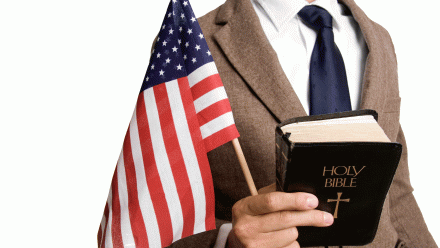

Can churches get political?
The question feels especially loaded for pastors as the heat of our political landscape seemingly burns hotter than ever.
Some want to see their churches take a stand for or against specific candidates or causes. Others wonder whether any stands taken by their churches should occur at all.
Stay informed on the legal, tax, finance, and risk issues affecting churches. Sign up for a free Church Law & Tax newsletter or become a member today for trusted guidance and practical resources from leading experts.
Many pastors feel caught in the middle.
To help, Church Law & Tax put together a free guide to help churches and pastors navigate political activities.
Video: Can Our Church Get Political?
The goal is to help leaders understand where lines exist, and how they should thoughtfully consider them before deciding how to act.
Thankfully, while the political landscape offers a lot of heat to our cultural moment, pastors and church leaders have an opportunity to bring light.
A fuller picture
Technically speaking, churches can get political. The Constitution’s Free Exercise and Free Speech clauses offer robust protections for churches and pastors to speak and act as they feel called based on their theological convictions.
Whether it’s endorsing a candidate for Congress or lobbying against a ballot measure involving, say, the legalization of marijuana, they can respond as they feel led.
But there’s more to consider.
Specifically, the Internal Revenue Service (IRS) lays out two requirements for nonprofits and churches in order to maintain their tax-exempt statuses.
One requirement, based on the controversial 1954 adoption of the “Johnson Amendment,” says tax-exempt entities cannot support or oppose political candidates, even to an insubstantial degree.
The other, based on an act of Congress from 1934, says churches can support or oppose ballot measures, or lobby for or against legislative matters—but only if these activities represent “no substantial part” of their overall operations. Defining “substantial” has proven elusive over the years.
Status quo
Adding to the ambiguity: Limited enforcement by the IRS. Only a handful of violations have ever been openly pursued by the agency.
An executive order issued by President Donald Trump in 2018 attempted to undo the Johnson Amendment but lacked any substantive legal effect.
A 2024 lawsuit brought by two Texas churches and the National Religious Broadcasters appeared destined to bring change when the IRS agreed to a settlement statement offering churches and religious organizations more leeway. But a federal judge dismissed the case on jurisdictional grounds.
The IRS listed updated guidance on the Johnson Amendment as a 2025-2026 priority, but until anything is issued, the status quo remains.
That leaves pastors and churches facing continued uncertainty. Should they support or opposed candidates? What stands should they take? Is risking their tax-exempt statuses worth it? Should tax exemption even influence a decision to begin with?
Room to advocate
Pastors and church leaders should first examine how God is calling their church to act, whether it involves a candidate or an issue.
For some, they are resolute about issues affecting their communities—or the country as a whole—and they believe they need to engage, as is their right.
The Constitution protects churches and pastors who wish to speak into these issues, and whether it comes from the pastor’s preaching, a pastor testifying on behalf of the church before a legislative committee, or other forms of advocacy, there is room to act.
Those actions won’t likely trigger IRS scrutiny, either, unless the time, money, and resources expended become a substantial part of the church’s operations.
While the constitutional protections remain when it comes to political candidates, the assurances of tax-exempt protection do not.
Even with relatively nonexistent IRS enforcement, pastors and church leaders must contemplate what a loss of exemption could mean for their congregations. Among the potential impacts:
- property tax exemptions;
- sales tax exemptions;
- charitable contributions deductions for donors;
- eligibility for certain types of retirement plans;
- availability of unemployment taxes.
More importantly, though, a church’s stand for or against a candidate or issue may invite division within the congregation itself. A 2024 survey by the National Association of Evangelicals reinforced these concerns, with 98 percent of pastors saying candidate endorsements should be avoided—largely because of the divisions they can cause.
A force for civic good
While there is an opportunity to bring light on key political issues during this election season, churches and pastors also have an opportunity to shine in another important way: they can support our country’s democratic processes.
For instance:
- Hosting nonpartisan forums inviting all candidates;
- Serving as a precinct location for elections;
- Compiling and distributing voting records (without commentary) of candidates on major issues;
- Conducting nonpartisan voter registration drives; and,
- Providing educational materials and hosting educational meetings about community issues, such as drug legalization, education reform, health care access, and economic development.
Can churches get political? Constitutionally speaking, yes.
Should churches get political? That’s a more nuanced question for every pastor and church, but one worth answering. There’s an opportunity to bring light, even in the heat of an election season.
Matthew Branaugh is attorney and editor of Church Law & Tax. Don’t miss Church Law & Tax’s free guide on churches and political activities and its “Politics and the Church: Activism, Speech, and the Tax Code” Recommended Reading page.