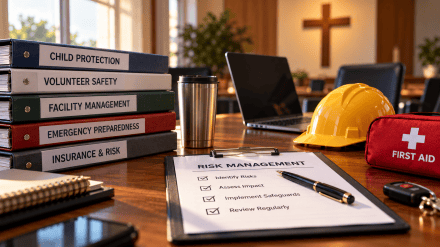
Most ministries don’t think much about risk management until something goes wrong.
A child is injured during an event. A volunteer is accused of misconduct. A severe storm damages the church building. An employment issue turns into a legal dispute. Or an emergency reveals that no one is quite sure who is responsible for making important decisions.
Risk management is not just an administrative exercise or an insurance issue— it is an act of stewardship that includes taking reasonable steps to identify vulnerabilities, reduce preventable risks, and prepare for the unexpected.
Build a Safer, Better-Prepared Church
Good risk management starts before something goes wrong. Church Law & Tax Advantage Members get practical guidance, policy templates, checklists, training resources, and trusted legal and tax insights to help identify vulnerabilities and strengthen their churches.
Become an Advantage Member and put trusted risk-management resources to work for your church.
One of the best ways to make that work sustainable is to assign responsibility to a team instead of expecting one individual to manage every area of exposure.
Who Should Be Part of a Ministry Risk Management Team?
The strongest ministries bring together a small group of leaders with different perspectives and areas of expertise to help identify risks, evaluate priorities, and ensure important issues do not go unnoticed.
Most ministries benefit from a team, though the right size depends on the ministry’s scale and structure. A smaller congregation does not need to form a committee for its own sake. The same process works well with one named owner, an honest annual review with the board, and outside help brought in once a year. Depending on the ministry’s size and structure, the team may include:
- A pastor or executive leader
- A board representative
- An administrative or HR leader
- A facilities representative
- A children’s or youth ministry leader
- A finance representative
- A local first responder with experience in law enforcement, fire services, emergency medical services, or emergency preparedness
The importance of the first responder
The first responder role is one that many ministries overlook, yet it is often one of the most valuable seats at the table.
Because these professionals have firsthand experience responding to real-world emergencies, they can help ministries identify risks that others may miss and evaluate whether existing plans will work under pressure.
For example, they may notice an exit blocked by stacked chairs, a building address that is difficult to see from the street, or an assembly area located in the path of arriving emergency vehicles. They can also provide insight into what responders need during the first few minutes of an incident and help determine whether an evacuation or emergency response plan is workable in practice rather than merely reasonable on paper.
Including someone with this background is one of the simplest and most effective ways to strengthen emergency preparedness and improve overall safety planning.
Many ministries also draw on outside partners, such as insurance professionals and legal counsel, who serve the team when a topic calls for their expertise without attending every meeting.
Stay Ahead of Risks Facing Your Church
Legal requirements change. New risks emerge. And yesterday’s policies may not protect your church tomorrow. Get practical guidance on risk management, child protection, cybersecurity, governance, tax, finance, and other issues affecting churches delivered straight to your inbox.
Sign up for our free weekly Church Law & Tax newsletter.
What Does a Ministry Risk Management Team Do?
Creating a team is only the first step. To be effective, team members need a shared understanding of what ministry risk management involves. While every ministry faces different challenges, healthy organizations tend to follow four basic steps when managing risk.
1. Identify Potential Risks
When people hear the term “risk management,” they often think about catastrophic events, such as natural disasters, serious injuries from accidents, or lawsuits. In reality, many ministry challenges begin with everyday activities, such as volunteer supervision, facility use, transportation programs, or child protection procedures that have become so familiar they no longer attract much attention.
One helpful question for leadership teams is: What could realistically disrupt our ministry, harm the people we serve, or damage the trust we’ve worked so hard to build? That question often reveals risks that have been overlooked for years.
2. Assess the Potential Impact
Once risks have been identified, leaders must determine which issues deserve the most attention.
Not every risk presents the same level of exposure. Some concerns are unlikely to occur and pose limited consequences. Others may be less likely but could have devastating financial, legal, operational, or reputational effects.
It helps to ask a few questions:
- How likely is this?
- Who would be affected?
- What would it cost?
- Could it interrupt ministry?
- Do we have safeguards in place today?
Ministries with effective risk management focus their time and resources on the areas with the greatest potential impact before moving on to lower-priority concerns.
3. Implement Safeguards and Controls
This is where risk management moves from awareness to action.
Once exposures are understood, ministries can take steps to reduce either the likelihood of a problem occurring or the severity of its impact.
The most effective safeguards are often the simplest and most repeatable:
- A documented children’s ministry check-in process
- A consistent driver screening procedure
- Written incident report forms
- Annual policy reviews
- Clear volunteer expectations and training
Each safeguard may seem small on its own, but together they create layers of protection that help ministries operate with greater confidence and consistency.
4. Review and Improve Regularly
Perhaps the most overlooked aspect of risk management is ongoing review.
Ministries are constantly evolving. New staff members join the team, programs grow, regulations change, facilities age, technology advances, and community expectations shift.
As a result, a policy or procedure that worked five years ago may no longer reflect current ministry operations. Rather than waiting for a problem to force change, the risk management team should build regular reviews of common risk areas into its annual planning.
How Ministries Use a Risk Management Team
The purpose of the team is not to create another committee. Its role is to provide accountability and ownership. In many ministries, the team serves as a resource to leadership by helping identify risks related to people, property, programs, and operations.
It may review incidents and near misses, evaluate safety and child protection practices, assess facility concerns, support emergency preparedness efforts, and recommend practical improvements.
For the team to be effective, leadership should establish three things:
- Authority: What decisions can the team make independently, and what should be escalated to senior leadership or the board?
- Rhythm: How often will the team meet, review policies, inspect facilities, evaluate incidents, and report back to leadership?
- Scope: Which areas of ministry will the team review? The five areas below offer a practical starting point.
Five Risk Areas Every Ministry Should Evaluate
Every ministry is different, but a handful of areas consistently create significant exposure. These five areas provide a practical starting point for evaluating a ministry’s overall risk profile.
1. Child Protection and Reporting
Few responsibilities are more important than protecting children.
Ministries often devote tremendous energy to creating welcoming environments for families. But hospitality alone is not enough. Effective child protection depends on documented systems that create consistency, accountability, and transparency.
Strong child protection systems help protect children from harm while also demonstrating that ministry leaders have exercised appropriate care and diligence in fulfilling their responsibilities.
In California, for example, AB 506 brought background screening and abuse prevention training expectations to many youth-serving organizations, and similar requirements have appeared in other states with meaningful variation between them. Church leaders should consult with qualified local legal counsel to determine what applies where they serve. Regardless of location, the principle remains the same: ministries have a responsibility to create environments that are safe, accountable, and worthy of the trust families place in them.
2. People and Volunteer Readiness
People are the ministry’s greatest asset. They are also an area where many risks originate when expectations, training, and accountability are unclear.
Every ministry should regularly evaluate its approach to volunteer screening, background checks, staff onboarding, leadership accountability, and ongoing supervision.
A lack of training, inconsistent supervision, or unclear boundaries can create vulnerabilities that are often difficult to address after the fact.
3. Programs and Activities
Ministries are active environments. Camps, retreats, mission trips, youth events, community outreach programs, transportation services, and special events all create opportunities for impact.
They also introduce unique operational risks. Before activities occur, leaders should consider questions such as:
- Have responsibilities been clearly assigned?
- Have volunteers been properly trained?
- Are emergency procedures documented and communicated?
- Do we have a crisis response plan?
- Have transportation risks been evaluated?
- Are drivers properly screened?
Taking time to evaluate these questions before an event often prevents problems that are far more difficult to address later.
4. Compliance and Governance
Leaders often place compliance in the “legal” category, but compliance is really a leadership responsibility.
Most compliance failures do not result from intentional wrongdoing. They occur because policies become outdated, responsibilities become unclear, or leaders are unaware that requirements have changed.
Strong governance helps prevent those gaps. Boards and leadership teams should regularly review policies, evaluate responsibilities, discuss emerging risks, and ensure accountability systems are functioning properly.
5. Coverage and Operational Alignment
One of the most common challenges ministries face is that their operations evolve faster than their insurance program.
New programs are launched, facilities gain additional use, counseling ministries expand, transportation activities increase, and staffing changes occur.
Yet many ministries rarely revisit whether their protection strategies still reflect those realities. Periodic reviews help ensure coverage remains aligned with ministry operations and that leadership understands both existing protections and potential gaps.
Final Thoughts
Effective risk management isn’t about predicting every possible problem; it is about building a ministry that’s prepared to respond wisely when challenges arise. The ministries with strong risk management are not necessarily the largest or best resourced. They are simply more intentional.
They build systems instead of relying on specific individuals. They document key responsibilities so important knowledge does not get lost when people leave. They train consistently, reinforce expectations over time, address concerns before they become larger problems, and regularly revisit their practices because they understand risk management as an ongoing part of faithful leadership.
Ultimately, risk management is not about eliminating every possible problem. It is about leaders stewarding the people, resources, and mission God has entrusted to their care. The goal is not perfection, but progress. Start by identifying one area that needs attention, then bring together the right people to help lead the conversation. Small, intentional steps taken today can strengthen ministry and help prevent significant challenges tomorrow.