
Online security seems to be a never-ending conversation.
I read recently where cybersecurity professionals are dropping out of what is increasingly a high-pressure, low-reward business. If everything stays safe, no one cares. But if a breach occurs, the pressure can be too much.
The age of artificial intelligence (AI) is not only powering some great advances in technology, but also some great advancements in evil. We should all desire to be good stewards of our data and that stewardship requires good security practices.
Church Law & Tax members get trusted guidance, practical tools, and expert insights to help protect their ministries from emerging cybersecurity threats, AI-driven scams, and other costly risks facing churches today.
Evolving Threats
AI has certainly added pressure because low-tech attacks now appear valid and credible.
The appeals made via email using broken English and poorly designed fake web pages are long gone thanks to AI tools that bad actors use. Fraudulent attempts now read and look legitimate.
However, there are steps you can take to protect yourself and your church, and thus avoid becoming a tech support burden.
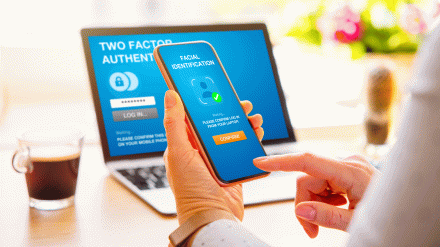
Two-factor (2FA) or multifactor authentication (MFA) is one way to protect yourself and your ministry online.
Examples of 2FA and MFA include codes sent via text or email or an authenticator app on a phone.
Everything that can utilize 2FA or MFA should utilize it, and if a system in your church office can’t, you might want to do a risk assessment before you proceed..
Breaking down 2FA
While not perfect, 2FA is the simplest way to protect your online accounts. Even in the age of AI, 2FA slows down the damage if you get phished or tricked into giving your password away.
While a great safety net, 2FA still requires some discernment.
Many times, 2FA fails because people get the prompt via an authenticator app and then blindly approve it without thinking through if they logged in or not.
You’ve probably also noticed that most 2FA codes sent via text or email remind you to NEVER give these codes to anyone.
Why?
Because scammers know if they can get the code, they can obtain your data. Many times, scammers can trick you into giving the code to them. After all, they might have already tricked you into giving them your password through a phishing scheme.
Use 2FA or MFA on everything and make sure to use a password manager to ensure you never repeat a password.
When it comes to ways to get a two factor or multi factor authentication code, the most common method is via SMS or text message. This is because that was first.
As technology evolved, authenticator apps became increasingly popular. From a security standpoint, the Authenticator app is the most secure. Text messages can be hijacked and stolen, making this method less secure. Still better than nothing, but less secure, nonetheless.
The challenge with authenticator apps is every provider has their own.
You look at some people’s phones, and they have 30 different two-factor authentication apps for all the various products or services they use. While that’s better than not having two-factor at all, there are some ways to streamline the process.
Google Authenticator, Microsoft Authenticator, Authy, OneAuth, and others offer a centralized way to track all of your two-factor authentication codes without having to have an app for each one.
Sign up for our newsletters to receive timely insights, practical tech guidance, and church-focused risk management content delivered straight to your inbox.
Conclusion
This side of heaven, no technology is perfect, and nothing is completely secure. But we must do our best to protect our data and the data of the ministries entrusted to us.
While not always the most convenient tool, 2FA and MFA provides reasonable security in exchange for a little inconvenience.
We should not fear AI, but rather, plan for its wise use, which includes our security posture through tools like 2FA. Who knows, we might even have to 2FA to get into heaven. Ok, maybe not, but we should at least work 2FA into everything here on earth.
Jonathan Smith is the President of MBS and the Chief Technology Officer at Faith Ministries in Lafayette, IN. He is an author and frequent conference speaker. You can reach Jonathan at jonathans@mbsinc.com and follow him on X @JonathanESmith.