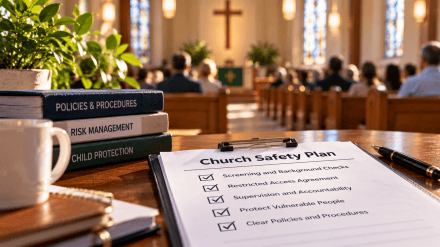

Should a known sex offender be allowed to attend worship or other church activities?
It’s a difficult question for churches wanting to practice hospitality, generosity, and grace.
The desire to support repentance and restoration must be balanced against a church’s legal and moral responsibility to protect its congregation and community from harm—and to protect the church from liability.
There is no simple answer. Churches considering this step should carefully assess whether they have the significant resources needed to mentor, supervise, and hold a known sex offender accountable. A breakdown in oversight can have tragic consequences, along with significant legal and reputational risks.
The following framework focuses primarily on public worship gatherings. It is not intended for settings such as childcare centers, schools, or other programs that require a different approach.
Nor does this information supply a substitute for legal counsel. Church leaders should consult qualified counsel about the specific circumstances involved.
What’s at Stake?
It is important to know that a church owes no legal obligation to permit a known sex offender to attend.
Any permission given depends on the church’s ability to provide meaningful oversight and accountability. Smaller congregations, in particular, may need to exclude a known sex offender because they lack the required support and supervision.
Failing to properly address these considerations poses several potential consequences, including new harmful behavior, negligence claims and potentially punitive damages, negative publicity, and possible liability involving leaders who fail to implement appropriate safeguards.
Who Is a Known Sex Offender?
Church leaders should not equate “sex offender” only with someone listed on a government sex offender registry. Registration generally depends on a conviction for a qualifying offense, while some sexual misconduct is never reported, charged, or successfully prosecuted. An offender also may have pleaded guilty to a lesser offense or no longer be subject to registration.
For risk management purposes, churches should consider their ability to supervise anyone known to have admitted to committing a sexual offense, been convicted of one, been listed on a sex offender registry, or presently under investigation for a sexual offense.
Put Safeguards in Writing
A church choosing to permit participation should adopt two key documents: a proactive church policy addressing care and safety for participants, and a written restrictive-access agreement signed by the offender. Attendance or participation should be expressly conditioned on strict compliance with the agreement and the church’s rigorous oversight requirements.
Conduct Thorough Screening
Before granting access, church leaders should evaluate the nature of the offense, sentencing terms and other restrictions, and the individual’s history since the offense. A designated leader should oversee both screening and ongoing supervision.
The process should include a reputable background check, while also recognizing that allegations that never resulted in charges or arrests, juvenile offenses, and other relevant information may not appear.
Put Strong Church Policies in Writing
Good intentions aren’t enough when difficult situations arise. Clear, well-crafted policies can help your church establish expectations, strengthen accountability, reduce risk, and respond consistently.
Church Law & Tax Advantage Members can browse our growing library of church policy templates and sample resolutions covering safety, governance, employment, finances, technology, and other critical areas of church operations.
Browse the Church Policy Templates and Sample Resolutions Library
When applicable, leaders should communicate with probation or parole officers and others involved in monitoring or rehabilitation. They can help identify restrictions, relevant history, rehabilitation efforts, and recommendations. The church should obtain appropriate written permission for participation.
Church leaders also should interview the offender to evaluate transparency, accountability, rehabilitation, repentance, and restoration. Any inconsistencies between the individual’s account and information obtained elsewhere should be resolved before participation is approved. The governing board should carefully evaluate the collected information before proceeding.
Require Close Supervision
If participation is allowed, restrictions should be specific. Violations must be treated seriously, too, such as through a zero-tolerance policy for violations and subsequent revocation of access.
The offender should be accompanied at all times on church property and at church-sponsored events by an approved sponsor. Multiple sponsors may be necessary for scheduling, and sponsors should be trusted, long-standing church participants who are not members of the offender’s family.
Sponsors should understand all restrictions and report regularly to the designated leader regarding attendance, participation, conduct, and anything that raises concern. Churches should maintain accurate and up-to-date records, including any contact with minors, whether intentional or inadvertent. Don’t count on institutional memory; use robust record-keeping systems and related alerts instead.
When applicable, leaders also should maintain communication with probation, parole, or other monitors. Concerns or violations may warrant immediately revoking permission to participate.
Put Victims and Vulnerable People First
Ministry to an offender should never come at the expense of a victim. A known sex offender should not be permitted to participate if the victim is involved with the church or becomes involved with the church.
Leaders also should consider the effect on survivors and other vulnerable people, particularly when the church operates ministries serving them. While a church may seek to care for all, sometimes the needs and risks for some outweigh the good that can be done for others. Not every church can fulfill every need.
Handle Disclosure Carefully
Information about an offender’s status should be handled sensitively. Broad disclosure may create risks involving privacy, defamation, gossip, inaccurate information, or inappropriate communications. Churches should work with legal counsel to determine what information should be communicated, to whom, and under what circumstances, while keeping safety paramount.
What This Means for Churches
Allowing a known sex offender to participate in church life is a substantial undertaking, not simply an act of welcome. It requires careful screening, written restrictions, dependable supervision, ongoing accountability, attention to victims and vulnerable people, and consistent enforcement.
Some churches may conclude they do not have the resources to do this responsibly. If a church does proceed, its safeguards should be carefully tailored to the individual circumstances and followed rigorously. A well-intentioned plan that cannot be consistently carried out may create untenable risks for everyone involved.
Sally Wagenmaker is a founder and partner in the Chicago office of Wagenmaker & Oberly, a law firm serving churches and other nonprofits, and a senior editorial advisor for Church Law & Tax.