

Tips for For Fostering An Emotionally Safe Children’s Ministry

An emotionally safe environment allows children to make friends and trust their teachers.

None of us intend to cause or allow a child to get hurt emotionally. Ideally, when a child comes to our classroom, we want them to feel safe to make friends with other children and trust the leaders. Above all, we want to create a safe haven where children can come to explore the mysteries of God, and discover his goodness.

Use these simple tips to help you create an emotionally safe environment in your children’s and youth ministry.

What to Avoid

  • Ignoring. Whether physically or psychologically, the parent or caregiver is not present to respond to the child. A child feels ignored when his teacher fails to make eye contact or call him by name.
  • Rejecting. This is an active refusal to respond to a child’s needs (e.g., refusing to touch a child, denying the needs of a child, ridiculing a child).
  • Verbally assaulting. Children feel verbally assaulted if they are belittled, shamed, ridiculed or verbally threatened.
  • Neglecting the child. This abuse may include educational neglect, where a parent or caregiver fails or refuses to provide the child with necessary educational services; mental health neglect, which denies or ignores a child’s need for treatment for psychological problems; or medical neglect, in which a parent or caregiver denies or ignores a child’s need for treatment for medical problems.

What You Can Do

  • Promote emotional literacy. Emotional literacy is the ability to identify, understand, and respond to emotions in oneself and others in a healthy manner. Children who have a strong foundation in emotional literacy tolerate frustration better, get into fewer fights, and engage in less self-destructive behavior than children who do not have a strong foundation.
  • Never be afraid to apologize. If you lose your temper and say something in anger that you shouldn’t have said, apologize. Children need to know that adults can admit when they are wrong. These situations are also a great time to explain how Jesus asks us to forgive—and that even adults need his help.
  • Bolster self-worth and confidence. Kids need adults who can identify and encourage their strengths. The message “I believe in you” can serve as needed affirmation today and an investment in a more confident tomorrow.
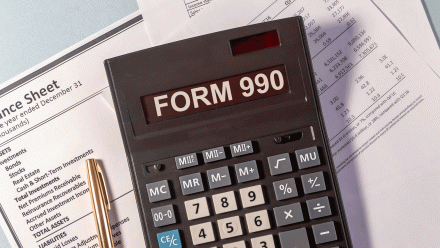
Form 990: Does Your Church Need to File This IRS Form?

A comprehensive guide on whether churches must file Form 990, including exemption criteria and legislative updates.

Last Reviewed: January 2, 2025

Are churches required to file Form 990 with the federal government? Here’s a detailed guide to help churches understand their filing obligations.

Key Takeaways:

  • Churches and certain religious organizations are exempt from filing Form 990.
  • Specific criteria define which organizations qualify for the exemption.
  • Proposed legislative changes could alter filing requirements for churches.

Churches are generally not required to file Form 990 with the IRS. This exemption is granted under Section 6033 of the Internal Revenue Code, which outlines specific criteria for exempt organizations.

Here’s what church leaders need to know.

Who Is Exempt from Filing Form 990?

Section 6033 specifies organizations exempt from filing Form 990. These include:

  • Churches, conventions, or associations of churches, and interchurch organizations of local church units.
  • Integrated auxiliaries of a church, such as men’s or women’s organizations, religious schools, mission societies, or youth groups.
  • Schools below the college level affiliated with a church or religious order.
  • Mission societies affiliated with churches, if over half of their activities target foreign countries.
  • Exclusively religious activities or religious orders.
  • Religious or apostolic organizations described in Section 501(d) of the Code.
  • Exempt organizations with annual gross receipts typically below $25,000.

What Is Form 990?

Form 990 is an annual return required for most tax-exempt organizations. It includes 89 questions covering finances, services, and administration. While this form ensures transparency and accountability, many religious organizations are exempt from filing due to their unique status.

Legislative Developments to Watch

Efforts are ongoing in Washington to require all religious organizations, including churches, to file an annual Form 990. If enacted, this could impact reporting requirements significantly. Stay informed on legislative updates that could affect your church’s obligations.

Example: A small mission society that conducts over half its activities abroad and earns less than $25,000 annually qualifies for the exemption.

Practical Steps for Compliance

  • Confirm your organization’s exemption status under Section 6033.
  • Stay updated on potential legislative changes affecting Form 990 filing requirements.
  • Consult a tax advisor or legal professional for guidance tailored to your church.

FAQs About Form 990

  • Are all churches exempt from filing Form 990? Yes, under Section 6033, most churches and related organizations are exempt.
  • What happens if filing requirements change? Churches will need to adhere to new regulations. Stay informed of legislative updates.
  • Do small organizations qualify for exemption? Yes, organizations with annual gross receipts below $25,000 are generally exempt.
  • Why is Form 990 important? It ensures transparency and accountability for tax-exempt organizations, but churches are uniquely exempt.

To learn more about Form 990 and filing requirements, visit the IRS website or consult a legal expert specializing in nonprofit tax law.

Richard R. Hammar is an attorney, CPA and author specializing in legal and tax issues for churches and clergy.
Related Topics: |

Ask Richie

đź‘‹ Hello! I'm Richie, your AI assistant. How can I help you today?
ajax-loader-largecaret-downcloseHamburger Menuicon_amazonApple PodcastsBio Iconicon_cards_grid_caretChild Abuse Reporting Laws by State IconChurchSalary Iconicon_facebookGoogle Podcastsicon_instagramLegal Library IconLegal Library Iconicon_linkedinLock IconMegaphone IconOnline Learning IconPodcast IconRecent Legal Developments IconRecommended Reading IconRSS IconSubmiticon_select-arrowSpotify IconAlaska State MapAlabama State MapArkansas State MapArizona State MapCalifornia State MapColorado State MapConnecticut State MapWashington DC State MapDelaware State MapFederal MapFlorida State MapGeorgia State MapHawaii State MapIowa State MapIdaho State MapIllinois State MapIndiana State MapKansas State MapKentucky State MapLouisiana State MapMassachusetts State MapMaryland State MapMaine State MapMichigan State MapMinnesota State MapMissouri State MapMississippi State MapMontana State MapMulti State MapNorth Carolina State MapNorth Dakota State MapNebraska State MapNew Hampshire State MapNew Jersey State MapNew Mexico IconNevada State MapNew York State MapOhio State MapOklahoma State MapOregon State MapPennsylvania State MapRhode Island State MapSouth Carolina State MapSouth Dakota State MapTennessee State MapTexas State MapUtah State MapVirginia State MapVermont State MapWashington State MapWisconsin State MapWest Virginia State MapWyoming State IconShopping Cart IconTax Calendar Iconicon_twitteryoutubepauseplay
caret-downclosefacebook-squarehamburgerinstagram-squarelinkedin-squarepauseplaytwitter-square