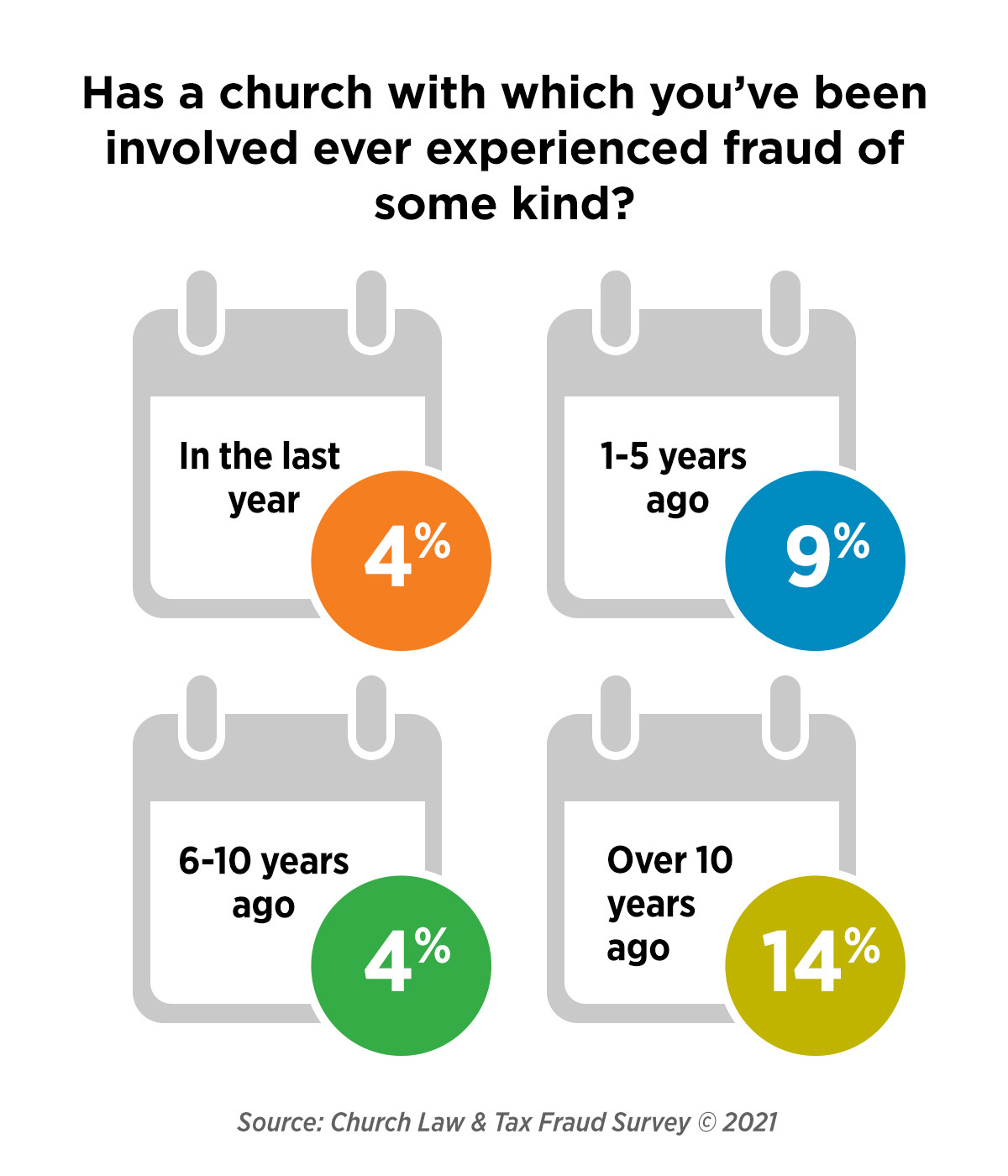
A nationwide survey of more than 700 church leaders conducted by Church Law & Tax shows nearly one-third serve in congregations that have suffered from some form of financial misconduct.
Among those experiencing it, half said an incident occurred within the past 10 years.
Prior research conducted by other organizations throughout the past 20 years has usually pegged the figure closer to 10 percent or 15 percent for houses of worship. Still, church financial experts have long estimated that the figure was at least one-third or even higher for all congregations across the nation—a figure that appears to track closely with the Church Law & Tax study from 2021.
“It was disheartening to see 30 percent of churches responding had experienced fraud,” said CPA Vonna Laue, a senior editorial advisor for Church Law & Tax who co-led the survey project. “It did confirm to me how prevalent this situation is in churches.”
Churches of all sizes, ages, and locations are susceptible, according to the survey’s findings—and fraud prevention experts say the vulnerabilities that perpetrators commonly exploit are ones easily remedied.
“The primary types of financial misconduct that occurred are the most preventable with a good internal control structure,” Laue said.
Yet many churches do not install simple safeguards out of a perceived high level of trust among their ranks, a noted frustration among the financial experts who reviewed Church Law & Tax’s results and provided comment.
“It will never happen here”
Two-thirds of survey respondents who said they weren’t aware of fraud in their churches also said they believe the problem is unlikely or “will never” happen in their churches. Ironically, among those who endured misconduct, half said they shared a similar “it-will-never-happen” sentiment before uncovering a case—and 80 percent then implemented several basic measures after the fact.
“This is one of the most important takeaways from this study,” noted Rollie Dimos, a Certified Fraud Examiner (CFE) and author of Integrity at Stake: Safeguarding Your Church from Financial Fraud. “Most people think that their church is immune from the risk of fraud because [their] staff and volunteers are trustworthy. . . . We trust people to do the right thing, but we can fail them if we don’t hold them accountable or provide controls to protect them.”
Nathan Salsbery, a CFE and a partner and executive vice president for nonprofit CPA firm CapinCrouse, said many congregations “do not implement effective internal controls until they feel the pain of fraud firsthand.”
Salsbery is currently assisting fraud investigations at three different churches. “Had these churches implemented a few basic internal controls, they would have either prevented the fraud or would have detected it much sooner,” he added.
A costly toll
The failure to prevent or quickly detect financial misconduct exacts heavy tolls on congregations. In a 2022 study, Gordon-Conwell Theological Seminary’s Center for the Study of Global Christianity estimates church fraud globally will total $70 billion a year by 2025.
The fallout extends beyond pure dollars, though, and often with devastating effects. In an analysis of the language used by respondents to Church Law & Tax’s survey, words associated with anger and sadness appeared repeatedly among respondents who experienced fraud.
“The financial losses can be staggering,” Salsbery said. “While the financial losses are bad enough, there are usually many other losses that result from the inevitable broken trust and relationships damaged by such long-term acts.”
Such damage is understandable, given the typical identity of the perpetrator and the amounts that he or she steals.
As the Church Law & Tax research shows, the profiles of offenders frequently included treasurers, board members, and middle-aged pastors. Financial losses were the largest among perpetrators with long tenures at their churches (see “Loved and Trusted: What Shocks Us Most about Fraud Perpetrators”).
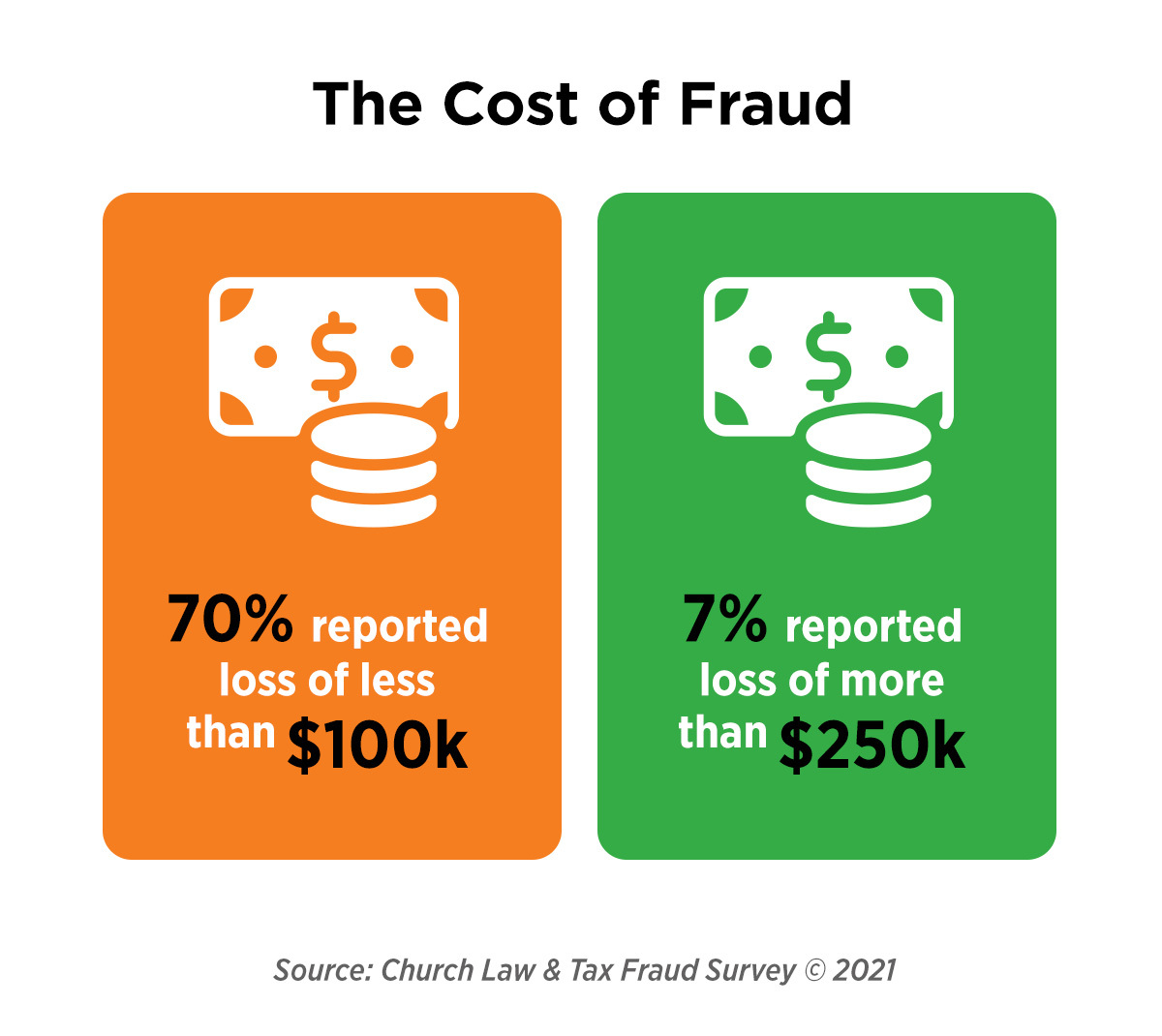
As for the amounts stolen, Church Law & Tax’s research showed 69 percent of those victimized said their losses measured less than $100,000. About 14 percent said the amounts topped $100,000, while another 15 percent said they did not know how much was taken.
Precise financial losses are difficult to pinpoint since the perpetrator may not know or may lie. And churches that choose not to contact law enforcement likely will miss out on learning the full extent because a thorough investigation never happens. Nearly 70 percent of victimized churches chose not to report their cases to police. Overall, only 22 percent of all respondents said their boards would contact law enforcement in the event a future suspected or actual case arose (see “Reporting Financial Crime as a Matter of Stewardship”).
Easy opportunities
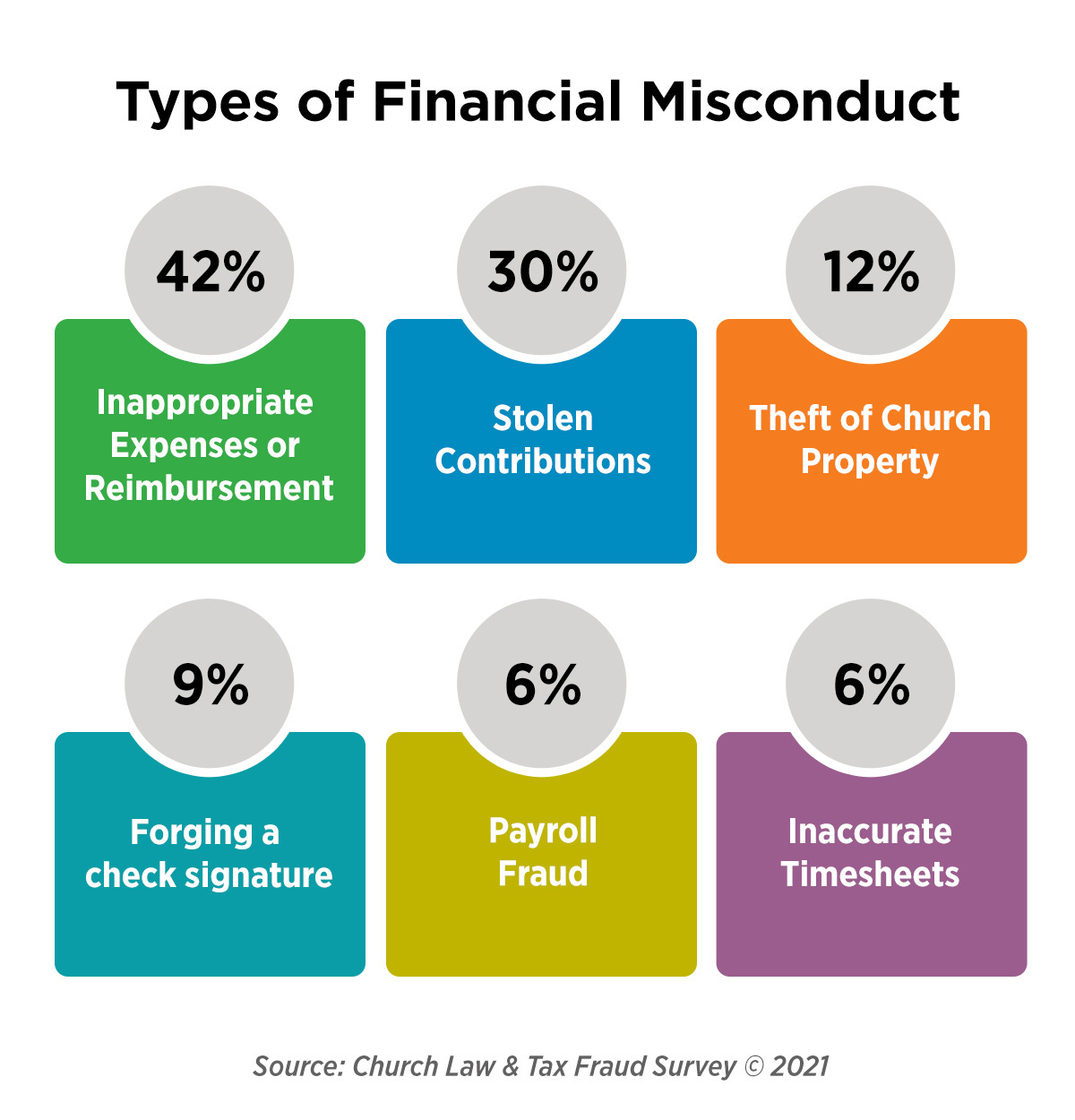
Nearly 42 percent of cases involved “inappropriate expenses or inappropriate expense reimbursements,” the survey showed. Slightly more than 30 percent involved stealing contributions. Payroll fraud and inaccurate timesheets combined constituted 12 percent of the cases. And another 11 percent took tangible church property, while about 9 percent forged check signatures. (Note: Respondents to the “Types of Financial Misconduct” infographic were asked to check all that apply.)
While the type of theft men and women committed against their churches varied, according to the survey, it generally boiled down to one thing: easy opportunities.
“While TV shows often depict fraud as grand and complicated schemes, most fraud committed in the church is simply an individual taking advantage of a situation where no one is looking,” Salsbery observed.
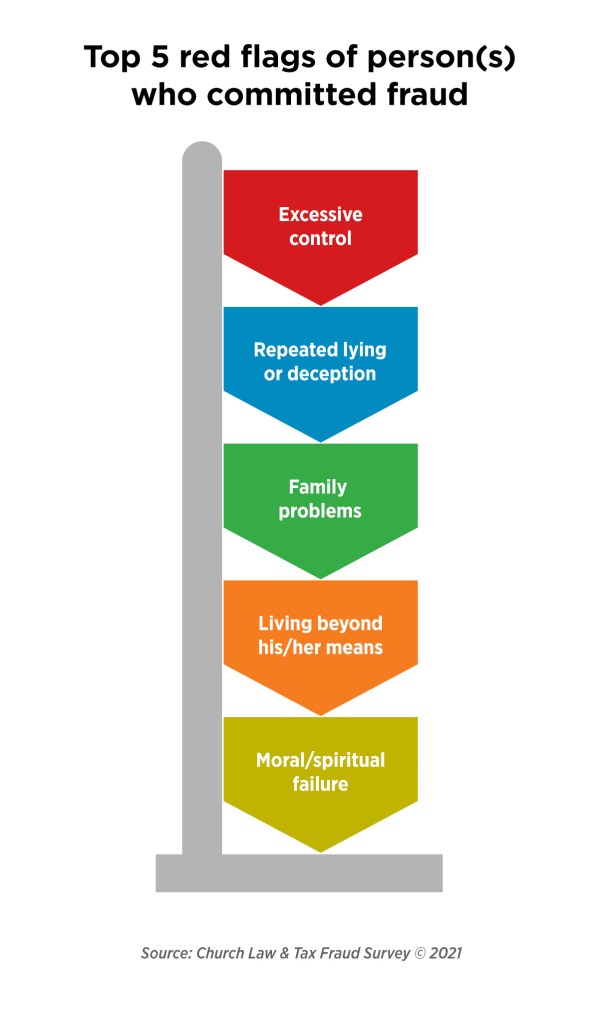
Just assigning another set of eyes to monitor a variety of financial activities could greatly reduce easy opportunities. For instance, the leading “red flag” for persons who committed fraud was excessive control over his or her duties or an “unwillingness to have others cover his/her job duties.”
“Nearly half of fraud schemes found were detected as a result of another employee performing a person’s duties” in their absence, noted CPA Michael Batts, another Church Law & Tax senior editorial advisor who reviewed the results. “The rotating duties of workers performing certain financial duties is, itself, an effective internal control mechanism, especially where adequate segregation of duties for a particular position is not in place.”
Encouraging signs—but much room for improvement
While the ease with which perpetrators stole from their churches is troubling, many of the practices best positioned to thwart such efforts do not require extensive time or expense.
On an encouraging note, many respondents indicated at least some best practices are already in place.
About 86 percent of all respondents regularly generate and review financial statements, and 83 percent make certain two unrelated people work together to handle financial tasks.
Around three-quarters of those who had experienced fraud said they use separate individuals—the “segregation of duties” in accounting parlance—for authorizing cash disbursements, maintaining custody or control over cash, and handling accounting responsibilities. (Note: Most of those who responded to the question about “segregation of duties” were in churches that had experienced fraud. Respondents highlighted in the “Top measures churches take to prevent financial misconduct” infographic were asked to check all that apply.)
Still, the responses for these categories show between 17 percent and 25 percent of churches are not performing these basic measures.
The percentages worsen when considering other areas of financial accountability or internal controls recommended by experts. For instance:
Slightly more than half of respondents said one person in their church has the ability to perform all aspects of cash disbursements without requiring another individual’s involvement. “That is a staggering statistic,” Laue noted.
Dimos said this problem, along with improper expenses or expense reimbursements—the leading type of fraud found in the survey—can be easily prevented by “[r]equiring a second person to review and approve all credit card purchases or reviewing invoices or reimbursement requests before signing checks.”
Additionally, “disciplined monthly reviews of cancelled checks (or images) and reviews of monthly credit card statements and related documentation and support [can] significantly reduce risk,” Salsbery said.
Only one-third of churches store their collections in a safe and secure manner and require dual controls for access when they cannot be immediately deposited at the bank (again, stolen contributions constituted the second-highest type of fraud in the survey).
Only one-third of churches have their payroll approved by someone other than the preparer and then reconciled to the church’s accounting system.
Only 22 percent apply accounting procedures to tangible property susceptible to theft, such as electronic equipment or bookstore inventories.
“The addition of internal controls to protect your church will not cost the church anything,” Dimos observed. “Having a second person—like a staff member, trusted volunteer, or board member—be responsible to review the bank reconciliation and bank statements, or review a general ledger detail report, can provide a great deal of accountability, but not add any extra expense for the church.”
Audits and assessments
Financial audits and fraud risk assessments offer additional protections for churches, although unlike the previously mentioned preventive steps, these typically come with a cost.
An ongoing audit process “can help a church greatly reduce the risk of misappropriation and embezzlement,” Batts said. Dimos agreed, adding the use of fraud risk assessments can go one step further and “help a church test their controls and identify potential weaknesses and risk areas.”
In the survey, about 24 percent of respondents conducted outside audits with a CPA, which involves documentation and third-party support of the financial information, Laue said. Thirty percent hired a CPA or financial expert to perform a less intensive outside review, which relies on inquiries and analytical procedures, Laue noted. Almost 38 percent said they perform internal audits using church staff and volunteers.
In terms of fraud risk assessments, nearly 51 percent said they do not use them at all.
Learning from “hard lessons”
Church Law & Tax’s survey “presents a strong case for churches to be proactive in preventing fraud,” Dimos said.
The fact that 30 percent of churches reported experiencing financial misconduct at some point, and that the possibility exists even more experience it without realizing it, reveals “the risk of fraud is very real in all churches,” Salsbery said.
While many will think the steps are unnecessary, or shouldn’t be necessary because people should know better, Salsbery pointed to examples of fraud contained in the Bible—including Judas’s thefts from Jesus and the disciples’ ministry account or Ananias and Sapphira’s attempt to deceive Peter—as reminders that anyone can succumb to temptation.
“Just as policies are put in place to help prevent other sins from damaging the church, controls are needed to protect churches from the sin of fraud,” Salsbery said.
And taking time now to review practices and strengthen them—especially when no apparent problem exists—only ensures church leaders are stewarding resources well, Laue added.
“Let’s learn from the hard lessons of others,” Laue said. “I strongly encourage churches to take the step and carefully review internal controls or even hire someone to help assess and implement better internal controls now. Even if fraud was never to occur, it won’t hurt for us to operate with good processes in place.”
NEW! Safeguarding Your Church’s Finances—a multi-session video course for pastors, board members, staff, and volunteers on the basics of fraud prevention. LEARN MORE!
Matthew Branaugh is an attorney and editor for Church Law & Tax.
Image: getty/bymuratdeniz
Reporting Financial Crime as a Matter of Stewardship
Reporting financial crime in your church is a matter of stewardship, yet many church leaders report not doing so, or even knowing how.
Reporting financial crime is a matter of stewardship, yet nearly 70 percent of churches that have experienced fraud chose not to report it to the police, according to a 2021 survey of more than 700 church leaders.
The spring 2021 study on financial misconduct surveyed 706 church leaders.
About one-third of leaders said financial misconduct had taken place in their churches. Among those churches that experienced fraud, only a third filed a report with law enforcement.
In my own experience, the vast majority of churches that know or believe financial misconduct occurred are reluctant to contact law enforcement.
These leaders told me they would rather handle the matter internally. Church Law & Tax’s nationwide survey confirms this.
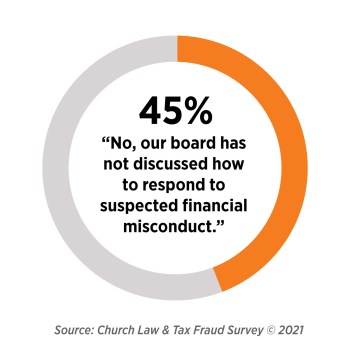
Additionally, nearly half of the respondents said their church boards have not discussed how they would respond to suspected fraud.
Why leaders do not report financial crimes
In the survey, leaders most frequently gave these explanations as to why they did not contact authorities:
We were able to recover the money without having to take legal action (27.7 percent).
We wanted to work on restoration with the individual(s) (26.5 percent).
We did not want to make it public to protect the church’s reputation (20.5 percent).
The church chose to forgive rather than report to the authorities (19.3 percent).
We did not want to make it public to protect the individual(s) (16.9 percent).
Legal action would go against the church’s ministry philosophy (7.2 percent).
(Note: Respondents were asked to check all that apply.)
When I speak with church leaders, their hesitations for contacting law enforcement often arise because the suspected embezzler is almost always a trusted member or employee, and church leaders are reluctant to accuse such a person without irrefutable evidence of guilt.
Seldom does such evidence exist. The pastor may confront the person about the suspicion, but the individual will often deny any wrongdoing—even if guilty. This only increases the frustration of church officials who do not know how to proceed.
Thinking of not reporting a financial crime?
Caution 1: The fraud is often far greater than the church realizes. A failure to report a financial crime may hide the true depth and extent of the crime committed. CPA Vonna Laue’s experience certainly affirms this. “Each time I have been brought into a ministry’s financial fraud situation, the amount of loss grew as more information was uncovered,” said Laue, a Church Law & Tax senior editorial advisor who advised this nationwide survey project. “It was always more than the perpetrator indicated and sometimes even they were surprised by the total.”
Caution 2: It does not matter whether the embezzler intended to pay back the embezzled funds someday. This intent in no way justifies or excuses the crime. The crime is complete when the funds are converted to one’s own use—whether or not there was an intent to pay them back.
Of course, an offender’s repayment may make it less likely that a prosecutor will prosecute the case. And even if the embezzler is prosecuted, this evidence may lessen the punishment. But the courts have consistently ruled that an actual return of embezzled property does not purge the offense of its criminal nature or absolve the embezzler from punishment for his or her wrongdoing. Also, note that church officials seldom know if all embezzled funds are being returned. They are relying almost entirely on the word of the thief.
Caution 3: Whether a church opts to notify law enforcement or not, there are tax law obligations with the Internal Revenue Service (IRS) that must be fulfilled.
Responding to suspected cases of fraud
Church leaders often learn of suspected financial misconduct because discrepancies or irregularities arise or someone submits a tip.
Top Six Red Flags
The survey indentified these signs that someone might be committing fraud:
1. Excessive control or unwillingness to have others cover his/her job duties
2. Repeated lying/deception
3. Family problems
4. Living beyond his/her means
5. Other moral or spiritual failures.
6. High levels of debt (e.g., credit card, student loans)
Along with these red flags, consider the following scenarios that point to the possibility that fraud might be taking place:
Giving is always higher when the person who usually does the counting is on vacation or ill during a weekend service.
A church bookkeeper lives a higher standard of living than is realistic given her or her income.
Church offerings have remained constant, or increased slightly, despite that attendance has steadily increased.
A church official with sole signature authority on the church checking account has purchased a number of expensive items from unknown companies without any documentation to prove what was purchased and why.
Safeguarding Your Church’s Finances—a multi-session video course for pastors, board members, staff, and volunteers on the basics of fraud prevention. LEARN MORE!
When unusual activity gets detected, or a tip is received, church leaders should take these steps in response:
1. Carefully gather information before reporting a financial crime
When evidence of actual or suspected financial misconduct surfaces, the pastor and/or church leaders should gather as much information as possible. Compile all documents and records that point to the possible irregularities and inconsistencies. The church should contact its attorney. It also should strongly consider hiring a qualified CPA firm or Certified Fraud Examiner (CFE) to conduct a more thorough investigation.
Note. Some churches have used CFEs to detect embezzlement and estimate the amount of loss. But note that CFEs are not required to be CPAs, and many have far less familiarity with accounting records than a CPA. The ideal professional would be a CPA who is also a CFE. For more information on CFEs, and to find one nearby, go to the website of the Association of Certified Fraud Examiners.
A deeper investigation offers the best way to quickly determine if the irregularities and inconsistencies are a product of human error or misconduct, and the amounts of money lost. If the cause is error, then the church can address the problem while avoiding making any erroneous and harmful accusations. If the cause is misconduct, then the church knows it must take appropriate next steps in whether to report a financial crime.
2. Sit down with the suspected perpetrator
If sufficient information points to a suspected perpetrator, at least two church leaders, and possibly the church’s attorney and the CPA or CFE (if one is hired) should meet with the person. Provide some general descriptions about the irregularities or inconsistencies that have arisen and ask the person what they can tell you about them. Take careful notes, including any questions or comments the person makes.
If the person confesses and asks how things will be handled, explain the criminal nature of the offense. Also explain the legal requirements to contact the IRS (see more below).
Caution. Always keep in mind that embezzlement is a criminal offense. Depending on the amount of funds or property taken, it may be a felony that can result in a sentence in the state penitentiary.
If the person confesses, evaluate with the church’s attorney the possible ways the person can possibly repay the stolen funds—but know that such a step does not absolve the person of his or her crime, nor does it eliminate potential consequences with the IRS. Also know upfront that such agreements by embezzlers to repay funds often are not honored.
3. Contact authorities
If there is a confession, or if the evidence clearly indicates the person stole church funds, church leaders must consider turning the matter over to the police or local prosecutor and the IRS. These are very difficult decisions, since doing them may result in the prosecution, penalization, and possible incarceration of a member of the congregation.
Note. Embezzlers never report their illegally obtained “income” on their tax returns. Nor do they suspect that failure to do so may subject them to criminal tax evasion charges. In fact, in some cases. it is actually more likely that the IRS will prosecute the embezzler for tax evasion than the local prosecutor will prosecute for the crime of embezzlement. Along with contacting local authorities, your church also should contact the IRS regarding the matter.
Before you “forgive and forget”
In some cases, a person confesses to the misconduct. Often, this is to prevent the church from turning the case over to the police or the IRS. Perpetrators believe they will receive “better treatment” from their own church than from the government. In many cases, they are correct.
It often is astonishing how quickly church members will rally in support of the embezzler once he or she confesses—no matter how much money was stolen from the church. This is especially true when the perpetrator used the stolen funds for a “noble” purpose, such as medical bills for a sick child.
Many church members demand forgiveness for the perpeator. The idea of turning the perpetrator over to the authorities is both shocking and repulsive. But is it this simple? Should church leaders join in the outpouring of sympathy? If the embezzler confesses, should church leaders leave it at that?
These are questions that each church will have to answer for itself, depending on the circumstances of each case.
Before forgiving the embezzler and dropping the matter, though, church leaders should consider the following.
Embezzlement is a crime breaches a sacred trust
The church should insist, at a minimum, that the embezzler must:
disclose how much money was embezzled,
make full restitution by paying back all embezzled funds within a specified period of time, and
immediately and permanently be removed from any position within the church involving access to church funds.
Closely scrutinize and question the amount of funds the embezzler claims to have taken. Remember, you are relying on the word of an admitted thief. That is why it is important to involve the church’s attorney, as well as a CPA or CFE, when suspicions first arise.
The embezzler must return the stolen money within a specific time or sign a promissory note agreeing to pay back the funds within a specific time.
Caution. An attorney should be consulted before the church has any discussions about an agreement with the embezzler about paying back stolen funds.
The church faces tax consequences for not reporting financial crime to IRS
The church needs to tell the embezzler that the stolen money is taxable income. Therefore, failure to agree to either of the above alternatives will force the church to issue him or her a 1099 (or a corrected W-2 if the embezzler is an employee) reporting the embezzled funds as taxable income.
If funds were embezzled in prior years, then the employee will need to file amended tax returns for each of those years to report the illegal income since embezzlement occurs in the year the funds are misappropriated.
Failure to report taxable income will subject the church to a potential penalty (up to $10,000) for aiding and abetting in the substantial understatement of taxable income under section 6701 of the tax code.
Note. If an employer is able to determine the actual amount of embezzled funds as well as the perpetrator’s identity, the full amount may be added to the employee’s W-2, or it can be reported on a Form 1099 as miscellaneous income. But remember, do not use this option unless you are certain that you know the amount that was stolen as well as the thief’s identity.
If the full amount of the embezzlement is not known with certainty, then church leaders have the option of filing a Form 3949-A (“Information Referral”) with the IRS. Form 3949-A is a form that allows employers to report suspected illegal activity, including embezzlement, to the IRS. The IRS will launch an investigation based on the information provided on the Form 3949-A. If the employee in fact has embezzled funds and not reported them as taxable income, the IRS may assess criminal sanctions for failure to report taxable income.
Caution. If the embezzler agrees to pay back the stolen money and does so, does this convert the embezzled funds into a loan, thereby relieving the employee and the church of any obligation to report the funds as taxable income in the year the embezzlement occurred? The answer is no.
Most people who embezzle funds insist that they intended to pay the money back and were simply “borrowing” the funds temporarily. An intent to pay back embezzled funds is not a defense to the crime of embezzlement.
The courts are not persuaded by the claims of embezzlers that they intended to fully pay back the funds they misappropriated. The crime is complete when the embezzler misappropriates the church’s funds to his or her own personal use.
There is yet another problem with attempting to recharacterize embezzled funds as a loan. If the church enters into a loan agreement with the embezzler, this may require congregational approval. Many church bylaws require congregational authorization of any indebtedness, and this would include any attempt to reclassify embezzled funds as a loan. Of course, this would have the collateral consequence of apprising the congregation of what has happened.
Reporting financial crime may be a matter of fiduciary responsibility and good stewardship
Viewing the offender with mercy does not mean forgiving the debt and ignoring the crime. Churches are public charities that exist to serve religious purposes.
Donors give money in support of those purposes.
Forgiving and ignoring embezzlement may not serve those purposes.
The church should care about other churches
As Church Law & Tax’s findings also reveal, the average tenure of embezzlers tended to be less than 10 years, and oftentimes measured less than 5 years.
Letting an offender off the hook and sending them on their way exposes other churches to the same behavior. No record of the offender’s activities will be available—and that means even a church that follows healthy screening and selection steps (including criminal background checks) will be unable to detect this person’s past offenses.
As Laue, the CPA who advised the survey project, also notes: “We have a responsibility to protect Kingdom resources, whether they are ours or someone else’s, and we can’t do that if we don’t take the necessary steps to make others aware of the fraudulent activity.”
The bottom line: Churches should report financial misconduct as an act of stewardship for the global church.
Case Study: A Repeat Embezzler. A church administrator embezzled over $350,000 from his church. He wrote unauthorized checks to himself and others from the church’s accounts, and used the church’s credit card on over 300 occasions to purchase personal items. Police officers were called and he made a full confession.
The church secured a $1 million civil judgment against him. He was prosecuted and convicted on four felony counts including forgery and theft, and he was sentenced to 32 years in prison based on “aggravated circumstances” (the large amount of money that had been stolen, the care and planning that went into the crimes and their concealment, the fact that a great number of checks were stolen and unauthorized credit card charges made, and breach of trust).
Several years earlier, the administrator embezzled a large amount from a prior church employer. However, that church chose not to initiate criminal charges, believing that he had learned his lesson.
This case study is taken from the “Embezzlement” section of the Legal Library.
Answers to other key questions about reporting financial crimes
Find detailed answers to the following questions about embezzlement in the Legal Library:
How does embezzlement occur?
How does a pastor handle someone who confesses to embezzlement during a confidential counseling session?
Can a church require a suspected embezzler to take a polygraph test?
How can a church avoid making false accusations?
How should a church discuss embezzlement with the congregation?
And as both the study and my own experience show, a most-troubling aspect of financial misconduct in churches is the unfortunate reality that many pastors and other leaders choose to handle fraud or suspected fraud internally—meaning they avoid involving a CPA or CFE, the IRS, and law enforcement. But the failure to report can be problematic for the reasons I have detailed in this article.
For the sake of practicing good financial stewardship, it is my hope and prayer that churches will carefully consider the advice I offer in this article. Most importantly, my hope is that churches will seek do all they can to prevent financial misconduct from happening in the first place through implementing a system of sound internal control.
Attorney Matthew J. Branaugh, content editor for Church Law & Tax, contributed to this article.
Richard R. Hammar is an attorney, CPA and author specializing in legal and tax issues for churches and clergy.
Image: AdobeStock/Pixel-Shot
Loved and Trusted: What Shocks Us Most About Fraud Perpetrators
A closer look at the men and women who steal from churches—and the red flags leaders should watch for.
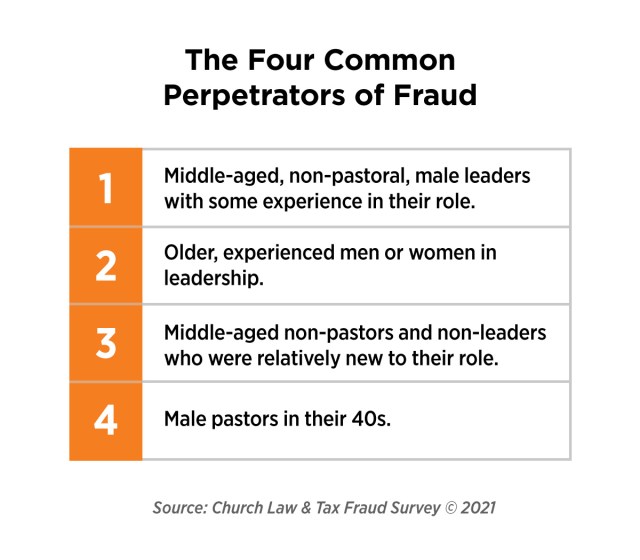
Church Law & Tax’s nationwide survey of congregations and the financial misconduct they experience paints four portraits of the types of individuals who most commonly steal from their churches.
What’s most shocking?
The positions of trust the men and women who commit these crimes carry.
The study revealed that common perpetrators included middle-aged men who served as treasurers or board members, sometimes for upwards of 10 years; men and women in their 30s and 40s who worked in their roles as administrators and treasurers for less than 5 years; and male pastors in their 40s.
And then there’s the group of perpetrators that may be the most surprising of all: men and women, typically 60 or older, who held their positions for 20 years or more. The crimes committed by these individuals “were disproportionately expensive” compared with other offenders, according to Arbor Research Group, the firm Church Law & Tax commissioned to survey church leaders nationwide.
“Just as fraud can happen in any sized church, fraudsters can be any age, any gender, and perform any function in the church,” said Rollie Dimos, a Certified Fraud Examiner (CFE) who reviewed the survey results ahead of publication and provided comment. “That’s why it is so important to put financial processes in place to actually protect our church team members from being tempted to steal God’s money. Internal controls are like guardrails that help keep people honest and accountable.”
Portraits of the perpetrators
The national survey fielded responses from 706 leaders and revealed nearly 30 percent served in churches that had experienced some form of financial misconduct. Nearly half said the crimes occurred within the past 10 years (see “Every Church Is at Risk for Fraud. Here’s Why”).
Those who suffered from some form of fraud answered questions exploring the acts committed and the people responsible for them. Through those responses, Arbor was able to classify the four classes of perpetrators, shedding more light on the common traits they possess.
Class 1
Arbor characterized this group as “middle-aged, non-pastoral male leaders with some experience in their roles.” These men frequently served as treasurers, board members, or in non-pastoral leadership roles.
Class 2
This group constituted “older, experienced men or women in leadership,” Arbor noted. They often served in their roles—which varied—for 20 years or more. A quarter of these cases resulted in losses of $250,000 or more, while half caused losses ranging anywhere from $10,000 to $250,000.
“The worst-case scenario for a church is to have fraud committed by long-tenured leaders in the church,” said Nathan Salsbery, a CFE and a partner and executive vice president for nonprofit CPA firm CapinCrouse who also previewed the survey results. “And if those leaders had unmonitored access to the cash coming in, the cash going out, and the accounting records, the financial losses can be staggering.”
More on Those Who Embezzle
Find additional examples of people steal from churches and how they do so—along with the consequences of such theft and ways to prevent and respond to it—see the “Embezzlement” section of Church Law & Tax’s Legal Library.
Class 3
This class featured the highest number of perpetrators, Arbor said. It, too, was evenly represented by men and women, but their ages ranged from 30 to 49 and their average tenures were 5 years or less. Among these individuals, about one-third worked as administrators, while 20 percent served as treasurers. Overall, 20 percent were unpaid volunteers.
Class 4
This group was comprised entirely of male pastors “typically 40 to 49 years of age and in their role 1 to 5 years,” Arbor noted. The thought of a pastor betraying his congregation in this way exacts significant tangible and intangible damage, Salsbery noted. “Lack of healthy accountability for senior leadership is one of the most significant risks to a church,” he said.
Red flags to monitor
The top “red flag” identified among the fraud cases disclosed in the survey—representing 32 percent—was “excessive control or unwillingness to have others cover his/her job duties,” according to the results. In fact, 47 percent of the cases weren’t discovered until another person performed the perpetrator’s duties for one reason or another.
The second-highest red flag was “repeated lying or deception,” followed by “family problems,” “living beyond his/her means,” and “other moral or spiritual failures.”
Lower on the list were “medical issues in family,” “expressed lack of job satisfaction,” and “loss of spouse’s job.”
When asked about red flags, a sizable portion of respondents selected “Other.” Asked to clarify, the bulk of the respondents said there either were no red flags, the person wasn’t caught and the fraud was later detected, or the red flags weren’t exhibited within the church and only learned of later.
In his comments about red flags, Dimos noted the “fraud triangle”—the illustration often used to describe financial misconduct. It forms a triangle with these three points: pressure (or incentive), rationalization, and opportunity.
“As church leaders, we can’t control what financial pressure someone may experience, like a family medical issue, nor can we stop people from rationalizing that it is okay to steal from the church,” he said. “But church leaders can create processes that prevent someone from having the opportunity to abuse funds.”
Red flags are consistent in other sectors
Interestingly, Church Law & Tax’s survey results closely tracked with the 2020 Report to the Nations by the Association of Certified Fraud Examiners (ACFE), Salsbery said. In particular, with greater positions of authority and tenure came greater degrees of losses for the organizations, he added.
The ACFE report showed the median losses for employee-caused fraud measured $21,000, then jumped to $95,000 for managers and supervisors, and $250,000 for executive-level positions.
“This correlation of higher fraud losses for long-tenured, experienced leaders makes sense. Given their influential leadership roles, they usually have more access to the assets of the church and have had that access for a long time,” Salsbery said. “The first two questions I ask ministries when I conduct [fraud investigations] is: (1) How long was the person in the role? and (2) What access did they have to bank accounts, other assets, and financial activities of the church during that time?”
Given the frequency and consistency of the red flags, whether in secular settings or church settings, leaders are actually positioned well to help protect their churches, noted Vonna Laue, a CPA and senior editorial advisor for Church Law & Tax who co-led the survey project.
“The red flags have not changed over the years in any study you review, and they are the same across entities from churches to Fortune 500 companies,” Laue said.
Leaders need “an awareness of the red flags,” she added, and give careful consideration when those serving in financial roles exhibit “at-risk behaviors.”
NEW! Safeguarding Your Church’s Finances—a multi-session video course for pastors, board members, staff, and volunteers on the basics of fraud prevention. LEARN MORE!
Matthew Branaugh is an attorney and editor for Church Law & Tax.
Key Tax Dates October 2021
Deadline for church employees with six-month extensions for filing 2020 tax returns.
If your church or organization reported withheld taxes of $50,000 or less during the most recent lookback period (for 2021 the lookback period is July 1, 2019, through June 30, 2020), then withheld payroll taxes are deposited monthly. Monthly deposits are due by the 15th day of the following month.
Note, however, that if withheld taxes are less than $2,500 at the end of any calendar quarter (March 31, June 30, September 30, or December 31), the church need not deposit the taxes. Instead, it can pay the total withheld taxes directly to the IRS with its quarterly Form 941. Withheld taxes include federal income taxes withheld from the employee’s wages, the employee’s share of Social Security and Medicare taxes, and the employer’s share of Social Security and Medicare taxes.
Semiweekly requirements
If your church or organization reported withheld taxes of more than $50,000 during the most recent lookback period (for 2021 the lookback period is July 1, 2019, through June 30, 2020), then the withheld payroll taxes are deposited semiweekly.
This means that for paydays falling on Wednesday, Thursday, or Friday, the payroll taxes must be deposited on or by the following Wednesday. For all other paydays, the payroll taxes must be deposited on the Friday following the payday.
Note further that large employers having withheld taxes of $100,000 or more at the end of any day must deposit the taxes by the next banking day. The deposit days are based on the timing of the employer’s payroll. Withheld taxes include federal income taxes withheld from the employee’s wages, the employee’s share of Social Security and Medicare taxes, and the employer’s share of Social Security and Medicare taxes.
October 15, 2021: Tax returns due for church employees with extensions
Last day to file a 2020 federal income tax return for taxpayers who obtained an automatic six-month extension by filing a Form 4868 by April 15, 2021.
Richard R. Hammar is an attorney, CPA and author specializing in legal and tax issues for churches and clergy.
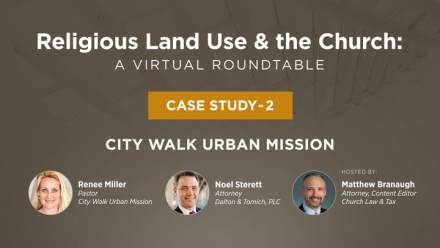
A zoning board sought to shut down City Walk Urban Mission in Tallahassee, Florida, through the enforcement of zoning code. This video case study shows how Pastor Renee Miller, the executive director of City Walk, worked with attorney Noel Sterett to successfully navigate the issue and continue the ministry’s work in Tallahassee.
Church Law & Tax members can watch the full Religious Land Use & the Church: Virtual Roundtable series, which includes an insightful discussion with leading attorneys, a companion PDF guide, and another video case study featuring a church that faced government challenges to a property it planned to purchase.
Matthew Branaugh is an attorney and editor for Church Law & Tax.
Religious Land Use & The Church: A Virtual Roundtable
A virtual roundtable of attorneys discusses an often overlooked religious land use law.
Featuring attorneys Midgett Parker, John Mauck, Noel Sterrett, Eric Treene, and Matthew Branaugh
The Religious Land Use and Institutionalized Persons Act (RLUIPA) was passed unanimously in 2000 by the US Congress and signed into law by President Bill Clinton. But nearly 25 years later, many church leaders remain unaware of how this law can help them avoid—or at least navigate—challenges posed by governments, agencies, and associations regarding the purchase or use of property for worship and other religious purposes.
This virtual roundtable, featuring attorneys Midgett Parker, John Mauck, Noel Sterrett, and Eric Treene, explores why every church should understand the ins and outs of this valuable law, even if your congregation has yet to experience any obstacles from local government or zoning officials or neighborhood associations. It is conveniently set up in five segments for church leaders to watch either individually or as a board, committee, or leadership team.
In addition, Matthew Branaugh, an attorney and editor for Church Law & Tax, shares two video case studies regarding how RLUIPA helped two pastors successfully overcome obstacles presented by their local officials.
To get the most out of the roundtable, we suggest you download this PDF. It will help guide you through the video series and offer helpful notes and highlights for future reference.
If your church references Robert’s Rules of Order Newly Revised in its bylaws—or uses it by tradition—it’s important to know that the 12th edition, released in late 2020, is now the current authority. This edition contains more than 89 substantive changes, and if your bylaws don’t specify an edition, the 12th edition now applies automatically.
Why This Matters
Most church bylaws that name Robert’s Rules automatically default to the latest edition. If your bylaws specify an older edition, such as the 7th (1970), you must use that version unless you amend your bylaws to state “the current edition.”
Key Point: If your church uses Robert’s Rules but hasn’t reviewed the updates in the 12th edition, now is the time.
Other Parliamentary Authorities
While Robert’s Rules is the most common, other worthy options exist.
What’s New in the 12th Edition?
Below are 17 significant changes church leaders should understand.
1. Motion to Lay on the Table
Cannot be used to kill debate.
Should only be used to set aside discussion temporarily for urgent matters.
Use “Postpone Indefinitely” to permanently end debate.
2. Vice President’s Role Clarified
Vice presidents act only when the president is absent.
Cannot appoint committees if the bylaws assign that to the president.
In succession cases, the VP becomes president unless bylaws state otherwise.
3. Executive Sessions
Discussions in executive session are secret.
Actions taken can be disclosed only as needed to implement them.
Assemblies may vote to release more info by amending previously adopted actions.
4. Electronic Voting
Secret ballots can be conducted using electronic keypads.
Write-in options and independent tallies are required for elections.
5. Board Minutes Access
Normally, only board members may view minutes.
Assemblies can vote to release minutes with a two-thirds vote or majority vote with notice.
6. Terms of Office
Actual terms may vary depending on meeting dates.
Bylaws should specify start and end points clearly.
7. Bylaw Revisions Must Be Authorized
Only a properly authorized committee can draft a full bylaw revision.
Critical Distinctions: Bylaws vs. Robert’s Rules
Robert’s Rules has increasingly addressed church governance areas better left to:
Church charters
Bylaws
Denominational documents
Nonprofit corporation laws
Rule 1: Church bylaws always override Robert’s Rules.
Rule 2: If Robert’s Rules covers non-parliamentary topics, those provisions are secondary to governing documents.
Examples:
If bylaws state a 20% quorum, and state law says 10%, use the bylaws.
The sequence of articles in your bylaws does not need to matchRobert’s Rules.
Additional Key Updates from the 12th Edition
8. Sample Rules for Electronic Meetings
Includes templates for various formats: internet, phone, hybrid.
Legal review is advised before adoption.
9. Excluding Nonmembers from Meetings
Assemblies can exclude nonmembers by a majority vote without entering executive session.
10. Ratifying Invalid Meetings
Actions taken at unauthorized meetings can be ratified.
Example: Online meeting held without bylaw approval can be validated post hoc.
11. Changing Ballots
Votes taken by secret ballot cannot be changed after submission.
12. Secrecy of Ballots
Ballot voting requirements cannot be suspended, even by unanimous vote.
13. Secret Ballots = Ballots
Clarifies that all ballots are considered secret by definition.
14. Ballot Voting by Mail
Bylaws should address tie-breaking procedures.
15. Ex Officio Officers
If not under the organization’s authority, they can vote but aren’t counted in quorum.
If they are officers, they must participate and count toward quorum.
16. Receiving Reports
No motion needed to “receive” a report.
Reports without recommendations can be filed.
Accepting a report = endorsing it fully.
17. Notice of Bylaw Amendments
Bylaws should specify deadlines for notice and delivery of amendment text.
If a conflict arises (e.g., quorum size or officer removal), always defer to the highest-ranked authority relevant to the issue.
Caution: If your bylaws or state law already cover an issue (like discipline or quorum), Robert’s Rules is not controlling.
Bottom Line for Church Leaders
Before adopting the 12th edition of Robert’s Rules—or assuming it applies—review your bylaws and understand what governs your church. If needed, seek legal counsel.
Additional Reading
Attorney Sarah Merkle, a professional registered parliamentarian and senior editorial adviser for Church Law & Tax, wrote a five-part series, “Mastering Meeting Basics,” which dives deeper into planning and leading church business meetings. She also authored a companion four-part series detailing a hypothetical case study that applies the rules and principles.
We’ve used a combination of AI and human review to make this content easier to read and understand.
Richard R. Hammar is an attorney, CPA and author specializing in legal and tax issues for churches and clergy.
Editor’s Note. This video is part of the Advantage Membership. Learn more on how to become an Advantage Member or upgrade your membership.
Churches today face an unprecedented number of employment-related issues, thanks to evolving state and federal laws and court decisions. Church leaders understandably wrestle with numerous questions as result, whether about the ministerial exception, discrimination laws, FLSA—and more.
Attorney and CPA Frank Sommerville, a Church Law & Tax Senior Editorial Advisor, recently published an article series covering ministerial exception, job descriptions, employee handbooks, and internships for ChurchLawAndTax.com. Now, in this one-hour webinar for Church Law & Tax, Sommerville provides his more than 30 years of legal and accounting expertise just for Advantage Members and their employment-related questions.
This exclusive webinar will help you and your pastors, executive pastors, HR directors, business administrators, and board members address any uncertainties, concerns, and ambiguities you face with employment matters.
If your church or organization reported withheld taxes of $50,000 or less during the most recent lookback period (for 2021 the lookback period is July 1, 2019, through June 30, 2020), then withheld payroll taxes are deposited monthly. Monthly deposits are due by the 15th day of the following month.
Note, however, that if withheld taxes are less than $2,500 at the end of any calendar quarter (March 31, June 30, September 30, or December 31), the church need not deposit the taxes. Instead, it can pay the total withheld taxes directly to the IRS with its quarterly Form 941. Withheld taxes include federal income taxes withheld from employee wages, the employee’s share of Social Security and Medicare taxes, and the employer’s share of Social Security and Medicare taxes.
Semiweekly requirements
If your church or organization reported withheld taxes of more than $50,000 during the most recent lookback period (for 2021 the lookback period is July 1, 2019, through June 30, 2020), then the withheld payroll taxes are deposited semiweekly.
This means that for paydays falling on Wednesday, Thursday, or Friday, the payroll taxes must be deposited on or by the following Wednesday. For all other paydays, the payroll taxes must be deposited on the Friday following the payday.
Note further that large employers having withheld taxes of $100,000 or more at the end of any day must deposit the taxes by the next banking day. The deposit days are based on the timing of the employer’s payroll. Withheld taxes include federal income taxes withheld from employee wages, the employee’s share of Social Security and Medicare taxes, and the employer’s share of Social Security and Medicare taxes.
September 15, 2021: Quarterly estimated tax payments for certain employees and churches
Filing for certain ministers and self-employed workers
Ministers (who have not elected voluntary withholding) and self-employed workers must file their third quarterly estimated federal tax payment for 2021 by this date. A similar rule applies in many states to payments of estimated state taxes.
Nonminister employees of churches that filed a timely Form 8274 (waiving the church’s obligation to withhold and pay FICA taxes) are treated as self-employed for Social Security, and as a result are subject to the estimated tax deadlines with respect to their self-employment (Social Security) taxes unless they ask their employing church to withhold an additional amount of income taxes from each paycheck that will be sufficient to cover self-employment taxes (use a new Form W-4 to make this request).
Payments for unrelated business income tax liability
A church must make quarterly estimated tax payments if it expects an unrelated business income tax liability for the year to be $500 or more. Use IRS Form 990-W to figure your estimated taxes. Quarterly estimated tax payments of one-fourth of the total tax liability are due by April 15, June 15, September 15, and December 15, 2021, for churches on a calendar-year basis. Deposit quarterly tax payments electronically using the Electronic Federal Tax Payment System (EFTPS).
Richard R. Hammar is an attorney, CPA and author specializing in legal and tax issues for churches and clergy.
Image: AdobeStock/ Irina
Part 3 of 6
Internships: Blessings or Blind Spots?
Explore the essential guide to church internship programs, covering legal compliance, FLSA rules, risk management, and strategies for training future church leaders while protecting your ministry.
This series of articles on church employment aims to help give clarity, offer best practices, and encourage tax and labor law compliance in several key areas of church employment:
Part 1Applying the Ministerial Exception to Church Employees
Part 2 Developing Strong Job Descriptions for Employees and Volunteers
Part 3 Internships: Blessings or Blind Spots?
Part 4 The Importance of a Legally Sound Employee Handbook
Many churches believe that part of their mission is to train the next generation of ministers and lay leaders. While Bible schools and seminaries provide information and knowledge, most individuals need hands-on experience to apply what they have learned.
In a tradition that goes back to Joshua serving and learning from Moses, churches open their doors to qualified individuals seeking hands-on experience. Churches frequently use the term “intern” to describe these workers.
Interns benefit from the work experience, résumé enhancement, career exploration, networking opportunities, and, sometimes, the potential for a job offer from the church. Unfortunately, the term “intern” does not have a statutory definition, so each church defines the term to suit its purposes. While the meaning of “intern” varies among churches, churches often believe that using the term allows them to escape all employment rules.
Note. For purposes of this article, the term “intern” means temporary workers serving the church as part of either formal or informal training to prepare for future service to a local church.
In addition to frequently failing to apply employment laws to interns, churches frequently fail to recognize the risks associated with interns. This article guides churches regarding the regulatory and risk environments for their internship programs, assisting them in constructing legally compliant internship programs, and avoiding common risks.
Applying employment laws to interns
The Fair Labor Standards Act (FLSA) imposes minimum wage and overtime requirements on qualifying employers and employees. While attorneys and law professors debate its application to churches, my experience is that most churches qualify as employers under the FLSA.
If a church does not qualify as an employer under the FLSA, individual employees at a church can still be covered by the FLSA. If FLSA does not cover either the church or the employee, then many state employment laws impose similar minimum wage and overtime rules on the relationship between the church and its employees. In any event, the church must consider the employment laws that apply to its relationships with interns.
Also, see the FLSA page from the US Department of Labor (DOL). Consult an employment lawyer or a human resources professional before making decisions about the application of the FLSA to interns and other employees.
Volunteer versus employee
No employment law applies to volunteers. Many churches consider their internship programs to be “volunteer” programs without genuinely understanding the term “volunteer.” As a result, some interns qualify as “volunteers” while many interns fail the volunteer test.
In this context, the volunteer test means the individual receives no compensation, expenses, or benefits from the church and volunteers his or her services solely for humanitarian or religious purposes.
The ban on compensation includes noncash compensation, such as housing, food allowances, and so on. If the church provides compensation (cash, scholarships, stipends, or noncash expenses, such as housing or gas), the worker does not qualify as a volunteer, and employment laws likely apply to that relationship.
FLSA and interns
Before reviewing the application of employment laws to interns, it is necessary to remember that no employment laws apply to workers classified under the ministerial exception. Therefore, it is essential, as with any other worker, to first evaluate the application of the ministerial exception to the intern position. If an intern receives compensation but qualifies for the ministerial exception, then the FLSA or state law equivalent does not apply to that intern.
Every intern that receives compensation and is not subject to the ministerial exception is likely an employee under either the FLSA or applicable state law despite common misconceptions held by many churches.
Defining who is an ‘intern’ under FLSA
The DOL has applied the FLSA to some interns since its inception in 1938, resulting in a US Supreme Court decision in 1947 (Walling v. Portland Terminal Co., 330 U.S. 148). The definition of an intern has evolved since then, especially as applied to interns in for-profit settings. Still, there are implications for churches and other nonprofits.
Consider, specifically, the DOL’s Fact Sheet #71, Internship Programs Under The Fair Labor Standards Act. It states that the DOL will apply a “primary beneficiary” analysis to determine the application of the FLSA to unpaid interns. It then lists seven factors that the DOL will consider the extent to which:
The intern and the employer clearly understand that there is no expectation of compensation. Any promise of compensation, express or implied, suggests that the intern is an employee—and vice versa (emphasis added).
The internship provides training that would be similar to that which would be given in an educational environment, including the clinical and other hands-on training provided by educational institutions.
The intern’s formal education program is tied to the internship by integrated coursework or the receipt of academic credit.
The intern’s academic commitments and academic calendar are accommodated by the internship.
The internship’s duration is limited to the period in which the internship provides the intern with beneficial learning.
The intern’s work complements, rather than displaces, the work of paid employees while providing significant educational benefits to the intern.
The intern and the employer understand that the internship is conducted without entitlement to a paid job after the internship.
Fact Sheet footnote
The DOL Fact Sheet then states in a footnote: “Unpaid internships for public sector and nonprofit charitable organizations, where the intern volunteers without expectation of compensation, are generally permissible.” Therefore, if interns receive no compensation, they may work at the church as volunteers. The FLSA will not apply even if the above DOL criteria are not fully implemented into the program.
Once the church provides any compensation (cash or noncash, actual or implied), the FLSA likely applies to the position, regardless of whether or not the compensation triggers tax consequences. Unless the ministerial exception applies, it is unlikely interns can be classified as “exempt” employees because they are typically paid less than the minimum salary requirement of $684 per week. So, the church must pay minimum wage and overtime to compensated interns.
Note. Twenty-nine states have set a higher minimum wage than the federal minimum wage. Also, California measures overtime on a daily basis.
The FLSA allows a lower minimum wage for certain qualified newly hired employees under the age of 20. This lower minimum wage applies only to the first 90 days of employment to allow for training. This lower minimum wage has many additional requirements, including that the younger worker cannot replace a regular worker. Unless the church specifically designed its internship program to meet the requirements of the lower minimum wage with the assistance of an employment attorney, this lower minimum wage will not apply to interns.
Calculating intern pay when the FLSA applies
Since interns are generally nonexempt, churches must require interns to keep timesheets because they need to prove interns are paid at least minimum wage.
Churches may pay a flat weekly amount (salary) as long as the timesheets show that the weekly amount meets or exceeds minimum wage, and that any overtime is paid if earned. Under the salary model, the salary cannot be reduced if the intern works less than 40 hours, and the church must pay overtime for all hours over 40.
Consider, for example, that an intern receives $400 per week. If the intern works 40 hours that week, the intern received at least the federal minimum wage.
But if the intern worked 60 hours, the intern has not received minimum wage ($6.15 per hour instead of $7.25 per hour). In that case, the church must increase the weekly amount to $435 (60 times $7.25). Now the church must add overtime compensation.
Two potential methods exist:
Method 1: 20 hours x $10.875 (1.5 x $7.25 x 20 hours) = $217.60. Under Method 1, the intern receives $435 + $217.60 = $652.60.
Method 2 (only applies if the salary model applies): 20 hours x $3.625 (.5 x $7.25) = $72.50. Under Method 2, the intern receives $435 + $72.50 = $507.50.
The DOL more thoroughly explains this calculation in Fact Sheet #82, Fluctuating Workweek Method of Computing Overtime Under the Fair Labor Standards Act (FLSA)/“Bonus Rule” Final Rule.
State labor laws
No discussion on interns is complete without considering state labor laws. Forty-five states have minimum wage laws. (Alabama, Louisiana, Mississippi, South Carolina, and Tennessee do not have state minimum wage laws as of August of 2021.)
If a church believes that the FLSA does not apply to it, that church still must comply with state labor laws. If its internship program meets the state definition of a training program and the intern qualifies for a lower minimum wage because they are less than 20 years of age, the church may pay qualifying interns a reduced minimum wage.
Consult an attorney
As noted above, many states have modified or eliminated this lower minimum wage program. Churches should confirm all the state and local minimum wage requirements before implementing an internship program at this lower minimum wage. The church should also work with a local employment attorney to design the internship program to meet the local, state, and federal requirements.
Further, all states have enacted a version of a payday law to protect employees from employers who may not always pay them what they are owed.
Additional Reading: Attorney Richard Hammar analyzes notable court decisionsabout common employment disputes.
These payday laws govern how frequently employees must be paid. For example, some churches only pay the intern at the end of the internship to encourage them to complete the internship term. But such practices violate state payday laws.
The mandatory maximum payday frequency ranges from one week to one month.
Here is a chart of maximum payday frequency maintained by the DOL.
Caution. There are penalties for violating payday laws, and the penalties can be stiff. For example, the Texas Payday Law imposes a $1,000 penalty for each violation.
Example. An internship lasts eight weeks. In Texas, since the intern is nonexempt, the payday law requires payment semimonthly. If the church paid a lump sum at the end of eight weeks, it would be subject to a penalty for each failure to pay the intern semimonthly during the eight weeks. Since only the last payday was timely, the church could owe up to a $1,000 penalty for each of three prior paydays.
Payday laws also prevent employers from deducting unauthorized amounts from an employee’s pay. Churches cannot deduct any amount other than payroll taxes from an employee’s pay without their specific written permission.
Payday law penalties apply if the church deducts anything other than payroll taxes from an intern’s paycheck without the intern’s written authorization, even if the church maintains a separate policy that requires the deduction from workers’ pay for amounts owed to the church.
Compensable Time Calculations
Churches must compensate non-volunteer and nonministerial exception interns for all time worked and on standby as defined by the FLSA because they are nonexempt. As mentioned earlier, all non-volunteer and nonministerial exception interns must maintain timesheets and provide them to the church.
The FLSA allows the employer to select the minimum time increment to measure time worked and/or on standby. Time can be measured in increments of a tenth of an hour (6 minutes) up to a maximum of a one-quarter hour (or 15 minutes).
Time worked and/or on standby
If interns subject to minimum wage laws show up early and sit at their desks, they begin accruing time paid for work when they sat at their desks. It does not matter if they were working or not. The same rule applies at lunchtime (see below) and if they linger after their shift ended.
If the church does not want to pay interns who report early or stay late, it should provide a breakroom for interns to use and not owe them pay for that time.
What about the compensation rules for off-duty calls, emails, and texts? In determining whether time spent responding to such communications is compensable, the factors that courts have considered include:
the average number of calls, texts, or emails the employee responds to during the off-duty period;
the required response time: in other words, how quickly the employee must respond and the amount of time spent responding;
whether an employee is subject to discipline for missing or being late to a call-back;
the extent to which an employee can engage in other activities while on-call; and
the nature of the employee’s occupation (in some jobs, it is the nature of the job to be paid to be available to respond immediately to a situation).
Some states require employers to pay a minimum amount of time for each off-duty call, email, or text where the person responded during off-duty time.
Travel
Business travel during a typical workday is compensable. Travel on weekends is compensable if during the typical weekday work hours.
Training
All training related to the employer is compensable.
Breaks, lunch, retreats, and camps
Breaks less than 20 minutes are compensable. Lunches of 30 minutes or more are not compensable. If the intern is on-duty 24 hours straight, then mealtimes and sleep are compensable.
Note. Some states have mandatory breaks and lunchtimes that must be compensated.
Employers who require interns to remain on the employer’s premises and to respond to calls and interruptions during an intern’s meal periods and sleep time are required, in most circumstances, to pay the interns for their meal periods and sleep time.
Retreats and camps present challenges to compensating interns. Frequently, the intern is required to be on duty 24 hours a day during the retreat or camp. Under the usual FLSA rules, the intern must be paid for 24 hours a day.
However, a church can avoid paying for on-duty sleep periods only if it has an express or implied agreement to exclude such periods from work time, the church has furnished adequate sleeping facilities, and the intern’s workday is 24 hours or longer.
Caution. Under no circumstances may a church avoid paying for on-duty sleep time if the intern has not had the opportunity to receive five or more hours of uninterrupted sleep. Finally, under no circumstances can a church exclude more than 8 hours of on-duty sleep time per 24-hour shift when computing an intern’s overtime pay. Some states have additional rules for camp workers that may apply to interns as well.
Tax Issues
If the intern receives compensation in any form, it is taxable unless a specific Internal Revenue Code section excludes the item from taxation.
The Internal Revenue Code, Section 119, excludes from taxation employer-provided meals and housing if (1) the employee must live in the housing and accept the meals as a condition of employment, (2) the housing or meals are located on the business premises of the employer, and (3) the meals that are provided must be required for the convenience of the employer.
A church cannot exclude the value of meals or housing from the intern’s taxable income unless it meets Section 119 requirements.
Example. A church rented an off-campus apartment for two interns during its program. Since the apartment rent does not qualify for exclusion under Section 119, the apartment cost must be split two ways and included in both interns’ taxable income.
Business expenses that are paid or reimbursed under a qualifying accountable expense reimbursement plan are excluded from taxable income. Intern meals and lodging cannot be reimbursed under a qualifying accountable business expense plan unless the expense would also be allowed for other church employees. For example, if an intern rented an apartment, the reimbursement of the cost of the apartment is added to the intern’s taxable compensation. On the other hand, if an intern conducted a Bible study with several students and bought pizza for them, then the pizza cost can be reimbursed tax free.
If an intern has received a ministerial credential (ordained, licensed, or commissioned) from a church, and the intern performs ministerial duties, a church may designate part of the intern’s compensation as a housing allowance under Section 107 of the tax code.
Note. If an intern qualifies as a minister for federal tax purposes, the church is also prohibited from withholding payroll taxes from that intern.
Craft job descriptions for all interns
Churches should have written job descriptions for interns. These written instructions help guide the church and the intern regarding expectations.
If the internship is for ministerial students, the church should draft a job description to qualify for the ministerial exception. If the internship involves nonministerial students, the church should consider structuring the program as a volunteer program to avoid employment compliance issues.
Again, though, even unpaid interns should have a job description detailing his or her responsibilities.
A Plan for Minimizing Risk
Unfortunately, the rigorous hiring and training processes utilized for other church employees are not always applied to interns. Yet, the church must proactively protect vulnerable youth and children from harm, and such protective measures with screening and selection should not be ignored for internship programs. In fact, interns can represent a significant risk to the church.
Protecting vulnerable populations requires a church committed to proper screening, selection, and supervision of pastors, ministry leaders, and volunteers—not just interns.
Learn more about how to do this with attorney and senior editor Richard Hammar’s 14-step plan for minimizing the risk of child and youth abuse in churches.
Churches should also utilize the other youth and child resources at Church Law & Tax to minimize this risk. Misconduct by a single intern in one summer can cost the church millions of dollars, cause the loss of members, and injure individuals that will carry serious emotional scars for life.
An opportunity to train
On the flipside, an internship provides an excellent opportunity to train the next generation about safely ministering in the real world and understanding the importance of protecting vulnerable populations.
Screening candidates, following up on references, and consistently enforcing policies and procedures can help mitigate risks.
Churches must screen interns with the same careful vetting process they use for potential employees. If the intern will work in the youth or children’s ministries, he or she should go through the same process used for any youth or children’s workers.
Reference checks for minors
Churches are hampered in using background checks because most interns are young and have little or no criminal history due to their ages, or such records are sealed as juvenile offenses. Reference checks and personal interviews will become the church’s primary screening tools.
For interns who will work in youth or children’s ministries, churches ideally should request references from youth-serving institutions where the prospective interns previously served. As attorney Richard Hammar, the senior editor for Church Law & Tax, notes, “The key question to ask is whether the institution is aware of any information indicating that the applicant poses a risk of harm to minors or is in any other respect not suitable for youth or children’s ministry.”
Churches also should request the names and contact information for the prospective intern’s current pastor, as well as his or her former pastors. If candidates do not list their former pastors as references, the church should still contact those pastors.
If a reference or former pastor refuses to respond to requests for a conversation about the candidate, the candidate should be rejected.
The church should include both men and women as reference interviewers to add their perspectives and impressions about the candidates.
Enforce policies and rules
In addition to the screening process, churches need policies and processes to protect vulnerable populations from interns who engage in risky behavior.
All church safety policies should be applied to interns. Since this is likely one of the intern’s first professional ministry experiences, the church must educate the interns about the church’s policies.
The church should actively take steps to make sure the rules are followed. Interns must understand that any violation will end the intern’s participation in the program.
Policies and rules regarding relationships and contact with children and youth should be strictly enforced. The church should prohibit interns from becoming involved romantically with any youth during their term at the church.
As a risk management tool, interns working with youth should be at least five years older than those in their ministry group. The church’s policy should prohibit interns from engaging in any one-on-one visits with children or teens that are not held in public areas on the church’s premises.
Phone calls, texting, and emails
Additionally, phone calls, texting, and emails with children and youth should not be allowed unless another adult (such as the child’s parent or youth pastor) is included in the communication.
Nearly all interns will use their personal cellphones to conduct church business during their internship. But cellphones present a frequent tool for grooming children and youth for harm.
Due to the risks arising from cellphone use, the church should notify intern applicants that the church may want to check their cellphones for inappropriate interactions with children and youth during their internships. Further, the intern could be told that the church requires its interns to submit their cellphones for surprise inspections by the church’s information technology (IT) department. (The church would keep all data from the phone unrelated to church business confidential.) The applicant should sign a written consent to the search as a condition of admission into the internship. If the applicant objects, the church may want to decline to invite that applicant.
Some churches require interns to submit a weekly written report of their interactions with their ministry groups outside of formal church events. The interns also should affirm weekly, in writing, that they have followed all policies and procedures required by the church.
Note. Not only should the interns be familiar with these rules, but parents and youth must also be familiar with these rules. No matter whether the church is addressing volunteers, employees, or interns, it is vital that the church educate parents, teens, and children about these rules and the grooming tactics predators use to gain the trust of victims and their families. Parents and youth must understand the importance of the rules in protecting everyone’s safety.
Additionally, the church should provide an easy way for parents and youth to easily report rule violations to church leaders.
Training future leaders
Internship programs provide valuable avenues for training the next generation of ministers and Christian leaders. However, as beneficial as these programs can be, incorrectly administered programs can also create substantial unforeseen liabilities.
The goal is to create internship programs that are either exempt from all employment laws or comply with all the employment and tax laws. It’s also essential that rules and policies are enforced that mitigate the risks noted above.
With careful planning, an internship program can provide meaningful assistance to training the next generation of ministers and future church leaders. It also provides the church with an excellent avenue of ministry.
Thanks to CPA Elaine Sommerville for her useful comments and edits to this article.
Churches should also utilize the other youth and child resources at Church Law & Tax to minimize this risk. Misconduct by a single intern in one summer can cost the church millions of dollars, cause the loss of members, and injure individuals that will carry serious emotional scars for life.
On the flipside, an internship provides an excellent opportunity to train the next generation about safely ministering in the real world and understanding the importance of protecting vulnerable populations.
Screening candidates, following up on references, and consistently enforcing policies and procedures can help mitigate risks.
Screen all candidates.
Churches must screen interns with the same careful vetting process they use for potential employees. If the intern will work in the youth or children’s ministries, he or she should go through the same process used for any youth or children’s workers.
Churches are hampered in using background checks because most interns are young and have little or no criminal history due to their ages, or such records are sealed as juvenile offenses. Reference checks and personal interviews will become the church’s primary screening tools.
For interns who will work in youth or children’s ministries, churches ideally should request references from youth-serving institutions where the prospective interns previously served. As attorney Richard Hammar, the senior editor for Church Law & Tax, notes, “The key question to ask is whether the institution is aware of any information indicating that the applicant poses a risk of harm to minors or is in any other respect not suitable for youth or children’s ministry.”
Churches also should request the names and contact information for the prospective intern’s current pastor, as well as his or her former pastors. If candidates do not list their former pastors as references, the church should still contact those pastors.
If a reference or former pastor refuses to respond to requests for a conversation about the candidate, the candidate should be rejected.
The church should include both men and women as reference interviewers to add their perspectives and impressions about the candidates.
Enforce policies and rules
In addition to the screening process, churches need policies and processes to protect vulnerable populations from interns who engage in risky behavior.
All church safety policies should be applied to interns. Since this is likely one of the intern’s first professional ministry experiences, the church must educate the interns about the church’s policies.
The church should actively take steps to make sure the rules are followed. Interns must understand that any violation will end the intern’s participation in the program.
Policies and rules regarding relationships and contact with children and youth should be strictly enforced. The church should prohibit interns from becoming involved romantically with any youth during their term at the church.
As a risk management tool, interns working with youth should be at least five years older than those in their ministry group. The church’s policy should prohibit interns from engaging in any one-on-one visits with children or teens that are not held in public areas on the church’s premises.
Phone calls, texts, and emails
Additionally, phone calls, texting, and emails with children and youth should not be allowed unless another adult (such as the child’s parent or youth pastor) is included in the communication.
Nearly all interns will use their personal cellphones to conduct church business during their internship. But cellphones present a frequent tool for grooming children and youth for harm.
Due to the risks arising from cellphone use, the church should notify intern applicants that the church may want to check their cellphones for inappropriate interactions with children and youth during their internships. Further, the intern could be told that the church requires its interns to submit their cellphones for surprise inspections by the church’s information technology (IT) department. (The church would keep all data from the phone unrelated to church business confidential.) The applicant should sign a written consent to the search as a condition of admission into the internship. If the applicant objects, the church may want to decline to invite that applicant.
Some churches require interns to submit a weekly written report of their interactions with their ministry groups outside of formal church events. The interns also should affirm weekly, in writing, that they have followed all policies and procedures required by the church.
Training future leaders
Internship programs provide valuable avenues for training the next generation of ministers and Christian leaders. However, as beneficial as these programs can be, incorrectly administered programs can also create substantial unforeseen liabilities.
The goal is to create internship programs that are either exempt from all employment laws or comply with all the employment and tax laws. It’s also essential that rules and policies are enforced that mitigate the risks noted above.
With careful planning, an internship program can provide meaningful assistance to training the next generation of ministers and future church leaders. It also provides the church with an excellent avenue of ministry.
The author thanks CPA Elaine Sommerville for her useful comments and edits to this article.
Frank Sommerville is both a CPA and attorney, and a longtime Editorial Advisor for Church Law & Tax.
Image: AdobeStock/MohamadFaizal
Part 4 of 6
The Importance of a Legally Sound Employee Handbook
A handbook not only protects the church and its staff—it also helps create a healthy relationship between employer and employee.
This series of articles on church employment aims to give clarity, offer best practices, and encourage tax and labor law compliance in several key areas of church employment:
Part 1 Applying the Ministerial Exception to Church Employees
Part 2 Developing Strong Job Descriptions for Employees and Volunteers
Additional Reading: Attorney Richard Hammar analyzes notable court decisionsabout common employment disputes.
Employee handbooks, sometimes called employee manuals or employee policies, often represent the Achilles’ heel of church legal compliance.
Employment lawsuits frequently appear near the top of all types of lawsuits against churches. Employee handbooks may assist in avoiding these lawsuits. And yet, churches often neglect this critical documentation. Or, they copy their handbook from secular sources that neglect the unique nature of churches and other religious organizations.
A handbook is a set of rules, policies, and procedures that govern the relationship between the church and its employees.
A carefully created handbook should include the church’s history, culture, core values, and mission. It should guide the church and its employees’ lives together and address employer and employee expectations arising from the relationship.
This article—the fourth in my series on church employment—will help churches and ministries create and maintain employee handbooks.
Common excuses for not having an employee handbook
In more than 30 years of working with churches, I’ve heard lots of excuses for not having a handbook.
Many small churches believe they are too small to need one. Other churches claim they lack the time, talent, and money to create and maintain a handbook. Some churches believe that a handbook frustrates and hinders the spiritual side of their work environments.
Then there are church leaders who dislike the restrictions that come with using a handbook. Many leaders believe the church is best served by making ad hoc decisions on an employee-by-employee basis, despite the fact that the resulting inconsistent employment decisions inevitably lead to adverse legal and nonlegal consequences.
Risks with Using Online Templates
Instead of drafting a handbook, some churches copy or download a handbook from the internet. This practice can create more problems than not having a handbook.
First, employee handbooks from secular sources will not reflect the unique nature of the church and its exemptions from some employment laws.
Second, the copied handbook may not reflect state laws and local ordinances accurately.
Finally, the church has no assurance that the source of the copied handbook is accurate or whether a competent church employment attorney reviewed it. It may be better for a church not to have a handbook than to have one that’s unreliable and inaccurate.
When closely examining these excuses from church leaders, all of them fail. And that failure likely results in legal liability. While most employment laws require a minimum number of employees, and thus do not apply to many churches, some employment laws apply to churches with just two or more employees. The legal vulnerability is real.
Mishandling employment-related matters may lead to disruption among the ranks of employees. It could also bring charges of unlawful employment actions–even if unintended. That’s why church leaders must make a concerted effort to create a well-drafted handbook.
While doing so requires effort, it will save church leaders time managing their staffs, reducing conflicts and legal liabilities. More important, the handbook can enhance the faith, trust, and community within the church.
While larger churches require professional assistance, the fundamentals of creating and maintaining a handbook are readily available.
Advantages of a handbook
Here are six key advantages to implementing a well-drafted handbook.
Provides organizational structure
In Part 2 of this article series, I discussed the importance of using job descriptions as the set of instructions that give structure for people to accomplish their respective roles in a church. Good structure doesn’t stop there, though. Every organization also needs policies and procedures that guide those leaders and employees.
A church may adopt dozens of individual policies and procedures, so wise church leaders will want those policies and procedures to be coordinated and consistent with each other. The church will also want assurances that it has addressed all the employment-related topics in its policies and procedures. Therefore, it makes sense to address all the employment-related policies and procedures in a single document, with references or hyperlinks to the detailed policies and procedures.
The church must also manage the handbook’s length to avoid making it too long to be useful. If the handbook exceeds 50 pages, many employees will not read it.
Assures compliance with employment laws
Church leaders must adopt policies and procedures to protect the church, to define the relationship between the church and its employees, and to comply with applicable laws. The handbook provides an important tool to accomplish these goals.
The governing body should approve and require continual maintenance of the handbook. The personnel committee, for example, should review the handbook annually to ensure that it complies with currently applicable laws. Governing bodies and personnel committees then must hold church leaders accountable for following and enforcing the policies and procedures referenced in the handbook.
Welcomes new employees to the church
Download PDF
The handbook introduces a new employee to the culture and work environment created by the church.
Nearly everyone experiences anxiety when reporting to a new job. The handbook should make new employees feel welcome. It should also answer most new employee’s questions about practices and benefits.
The handbook should describe the church’s doctrine, code of conduct, culture, and explain the relationship between the employee and the church, including the church’s expectations. The new employee’s compliance with these expectations helps assimilate him or her into the church team and reduces conflict. The handbook helps the new employee more quickly become a productive team member.
Assists with communication
The handbook should help prevent miscommunication between church leaders and church employees.
For example, listing the church’s doctrine, rules of conduct, and the employment benefits it offers provides a basis for a common understanding between church leaders and staff.
Handbooks, however, are of little use if they are not read or understood by employees. Churches want to encourage new employees to ask questions early in the relationship. If an employee does not understand a part of the employee handbook, the church needs to know as soon as possible.
So, churches should require new employees to read the handbook within the first few weeks of employment, and signal they understand it by signing a statement to that effect. When the church later disciplines an employee for violating a provision in the handbook, the typical employee excuse is, “I did not understand.” This signed document refutes that notion and supports the church’s disciplinary action.
Church leaders should refer employees to the handbook for common employment-related questions. While no handbook will answer all questions, it should reduce the time leaders spend responding to employee questions.
Avoids unreasonable employee demands
One crucial benefit of a handbook is to maintain consistency and to avoid situations where an employee might make unreasonable requests based on difficult or emotionally charged circumstances.
Consider, for example, the employee who sought a raise because his son was starting college and the employee had no resources for college. Or consider a pastor who requested his church to continue his compensation for as long as he or his spouse live because he had failed to participate in the church retirement plan.
By addressing these and similar issues in the handbook, the church establishes objective rules and expectations that help protect the church and its decision-makers from the unreasonable demands of employees, including pastors.
Helps protect the church from litigation
Most employment laws authorize employees to sue the employer for violations of those laws. In addition, some churches must comply with dozens of federal, state, and local employment laws and ordinances.
While church leaders rarely have the time to learn about all the employment laws and ordinances that apply to their church, the handbook can include instructions on how the church complies with employment laws and ordinances. If the church follows its handbook, the opportunity for employees to sue the church is reduced.
A handbook is a legal document, although usually not enforceable as a contract (see “Recommended disclaimers” below).
To ensure it is properly constructed and remains current, it should be regularly reviewed by an attorney or human resources (HR) professional, ideally one locally based who specializes in church employment law.
Decide on the tone
The tone of the handbook should reflect the culture of the church.
If the church culture is formal, the handbook should reflect formal language. If the church culture is informal, the handbook should use a conversational style.
Some churches include photos and illustrations to break up page after page of text. Some handbooks are made more engaging by including hypotheticals and examples. Sometimes churches use anecdotes to illustrate the text and make it more understandable.
Tip. If the “why” behind the policy is explained, employees will more readily adhere to the policy.
Most handbooks for churches start with a letter from the pastor that welcomes employees to the church. This letter helps set the tone for the handbook and introduces employees to the church’s culture, mission, and values. In addition, many handbooks include a history of the church, vision statement, mission statement, and core values statement.
What goes into an employee handbook?
Churches should review the following topics to determine whether they apply to them.
Statement of faith
One of the most critical parts of a handbook is the church’s statement of faith. As a religious organization, churches have the freedom to practice their faith in many of their employment decisions. The statement of faith demonstrates to employees and outside authorities alike that these are sincerely held religious beliefs.
The statement of faith should not be a lengthy treatise. Instead, it should reflect the church’s fundamental beliefs, especially as those beliefs relate to the current culture. Typically, the statement of faith is one to two pages long.
I recommend that churches require job applicants to agree to the statement of faith before applying for a job. I do not recommend copying another church’s statement of faith unless the source church is part of the same denomination or faith group. The statement of faith must reflect the local church’s beliefs as practiced by that church.
Code of conduct
The handbook should include a code of conduct that applies to all employees, including pastors.
Violations of the code of conduct should cause a disciplinary action against the employee. Some states allow the church to apply the code of conduct based on the employee’s conduct both at work and away from work.
The code of conduct should reflect the church’s values, along with the actions expected of its employees. The code should be practical and expressed in terms of right and wrong behaviors. This code should include the church’s expectations of honesty and integrity while condemning dishonest and unlawful behaviors. It should reflect the church’s doctrine and practices as applied in the current culture. I suggest supplying Scripture references where applicable.
Recommended disclaimers
The handbook should include the following disclaimers.
First, it should state that all employees serve at the pleasure of the church and that the church follows the employment “at will” doctrine (except in Montana). The employment “at will” doctrine means either the employer or employee can terminate the relationship at any time, with or without a reason, as long as the reason does not violate an employment statute.
Second, the handbook should state that it does not create a contract between the church and the employee. The existence of an employment contract alters or eliminates the employment “at will” doctrine. Without this disclaimer, some courts have ruled that the handbook eliminated the “at will“ doctrine and enforced the handbook as a contract.
Third, it should notify employees that the handbook can be changed at any time without notice, although employees still should be informed of changes in a timely manner.
Finally, it should make it clear that employment is not for any specific length of time.
Topics based on federal statutes
Most churches must adhere to federal employment statutes. The best way to assure compliance with these statutes is to adopt policies and procedures that reflect how the church complies with those statutes. Therefore, the church should consider whether its handbook should address each of the topics arising from the federal employment statutes below as they apply to the church. While I have attempted to list all federal employment statutes applicable to churches, the list may not be comprehensive.
Note. While most churches are subject to federal employment statutes, all states also have employment statutes. Usually they mirror the federal statute and apply to employers that would otherwise be exempt from the federal statute. If a conflict between the statutes arises, the most-employee-favorable statute will apply. Additional information on state statutes is given below in the “Topics based on state and local statutes and ordinances” section.
Churches also should note the applicability (or not) of statutes based on the ministerial exception for ministerial positions.
As explained in Part 1 of this series, the ministerial exception doctrine requires that no federal or state employment statute applies to positions involved in the practice of the religion. The handbook should include an extensive discussion about the ministerial exception and its application to employment laws. For help in understanding and correctly applying the ministerial exception, see Part 1.
Title VII, Civil Rights Act of 1964
This statute applies to churches engaged in interstate commerce with 15 or more employees during 20 or more weeks during a calendar year. In addition, Title VII prohibits employers from refusing to hire, discharge, or otherwise discriminate against any individual about compensation, terms, conditions, or privileges of employment based on race, skin color, religion, gender, ancestry, or national origin.
Note. In June 2020, the Supreme Court expanded the definition of prohibited gender discrimination to include sexual orientation, sexual perception, and gender identity. While the Court’s decision excluded its application to religious employers, the church should be prepared to address its position on these categories with assistance from an attorney.
The church should not fail or refuse to hire, discharge, or discriminate against any individual within any protected class unless a religious exception applies (see “Exception” below). The church cannot limit, segregate, or classify its employees or applicants for employment that would deprive or tend to deprive any individual of employment opportunities or otherwise adversely affect their status because the employee is in a protected class.
This statute applies to all terms of employment, including recruiting, hiring, placement, promotion, termination, layoff, recall, transfer, leaves of absence, compensation, and training.
Exception. As mentioned briefly above, churches may discriminate based on religion for positions involved in the practice of the religion. If the church expects all employees to align with its faith and practices, it might be able to use the church autonomy doctrine to hire and retain employees who agree with its sincerely held beliefs.
If an adverse employment decision involves a mix of religious reasons and other protected class characteristics and the church autonomy doctrine does not apply, the church may still be liable for discriminating against the other protected class or classes.
The handbook should include a statement that the church follows Title VII to the extent it applies to employment positions at the church.
Still, the handbook should not include religion in the list of classes protected by Title VII. Instead, the handbook should state the church bases employment decisions on religion when allowed by law and it reserves all rights available under Title VII.
Americans with Disabilities Act (ADA)
This statute applies to churches engaged in interstate commerce with 15 or more employees.
The church may not discriminate against disabled individuals as defined by the ADA. A person has a disability if he or she has a physical or mental impairment that substantially limits a major life activity.
The ADA also protects individuals who have a record of a substantially limiting impairment and people who are regarded as having a substantially limiting impairment. A substantial impairment significantly limits or restricts a major life activity such as hearing, seeing, speaking, breathing, performing manual tasks, walking, caring for oneself, learning, or working.
The handbook should state that the church complies with the ADA if it has 15 or more employees.
Caution. The church must evaluate applicants for positions based on their ability to perform the job’s core functions, with or without accommodation. Those core functions should be described in the job description.
The church should reasonably accommodate qualified individuals with known disabilities unless, by doing so, the church experiences undue hardship. These concepts should be included in the handbook to ensure they are top of mind for the church’s decision-makers.
Pregnancy Discrimination Act (PDA)
This statute also only applies to churches with 15 or more employees.
The PDA forbids discrimination based on pregnancy with any aspect of employment, including hiring, firing, pay, job assignments, promotions, layoff, training, fringe benefits, such as leave and health insurance, and any other term or condition of employment. In addition, this statute applies even if the individual became pregnant while violating the church’s code of conduct by engaging in sex outside of marriage.
The PDA also prevents discrimination against nursing mothers. The employer must provide a private room, other than a restroom, for expressing milk. It also must provide unpaid breaks to allow nursing mothers time away from their workstations to express their milk for up to one year after giving birth. Some states give nursing mothers additional rights and mandatory accommodations.
The handbook can honor individuals protected by the PDA and state that the church complies with the PDA if it has 15 or more employees.
Harassment
Title VII applies to harassment based on the Title VII protected classes. Harassment is illegal when it is so frequent or severe that it creates a hostile or offensive work environment or when it results in an adverse employment decision (such as the victim being fired or demoted).
Churches must protect employees from harassment by members, vendors, volunteers, and other employees. The handbook should include:
A definition of harassment. Harassment can include “sexual harassment,” including unwelcome sexual advances, requests for sexual favors, and other verbal or physical harassment of a sexual nature. Many courts have expanded harassment to include bullying.
The process for reporting the harassment. The church should include multiple places and ways to report harassment. Some female employees are reluctant to report sexual harassment to a male. The available places to report harassment should include at least one female. Also, the church cannot have a subordinate receiving harassment reports against a higher-level employee. If the harassment report is against a church leader, the handbook should include a way to report to a governance board member or the church’s outside law firm.
The process for investigating the harassment. Remember that subordinates cannot investigate claims of harassment against persons above them in the organizational chart. The church’s HR director frequently investigates claims against nonleadership employees. The investigation should be completed and reported to the complaining employee within ten days after receipt of the claim.
The penalties for harassment. The handbook should state the penalty can include termination or probation. It should also bar retaliatory actions against those who file a report, but it should allow disciplinary actions against those who file a false report or file one in bad faith.
Occupational Safety and Health Act (OSHA)
Employee safety needs to be addressed in the handbook. Churches must report to OSHA all work-related deaths, in-patient hospitalizations, amputations, and eye losses. If the death occurs within 30 days of the work-related incident, the church must report the death within 8 hours of learning of it.
For any in-patient hospitalization, amputation, or eye loss that occurs within 24 hours of a work-related incident, the church must report the event to OSHA within 24 hours of learning of it.
The handbook should state that the church takes employee safety seriously and complies with the employee safety requirements and OSHA rules that apply to the church.
Note. OSHA does not apply to a church’s religious employees. Also, while much of OSHA’s detailed recordkeeping does not apply to a church, all other provisions may apply to church-operated schools, daycare centers, and other administrative personnel of the church.
Fair Labor Standards Act (FLSA)
FLSA applies to most churches because it covers enterprises that engage in interstate commerce. Thus, even if the church conducts no activities or business outside its home state, the FLSA also applies to individual positions involved in interstate commerce. For example, if an administrative assistant regularly orders office supplies over the internet, the position is likely covered by the FLSA even if the church is not a covered enterprise.
Note. Forty-five states have a similar statute that applies even if the FLSA does not apply. Sometimes the state version of the FLSA is more employee-favorable than the FLSA. If the FLSA does not apply, then the state law equivalent will apply. I recommend that all churches follow the FLSA and state minimum wage and overtime laws because employees expect it, and noncompliance can be costly.
Handbook must-haves
FLSA requires employers to pay minimum wage and overtime to nonexempt workers. Therefore, the handbook should address these issues:
Worker classifications. A brief description of the different FLSA classifications: ministerial exception, exempt, and nonexempt. Many churches wrongfully classify certain workers as exempt. Churches may have numerous different and self-made definitions of various employee categories. The handbook should be tailored to meet the church’s employment model, but the church should be cautious of creating employee categories that cannot be managed lawfully and efficiently.The US Department of Labor (DOL) provides a safe harbor for the misclassification of exempt and nonexempt employees. If the handbook allows employees to appeal their misclassifications to the church’s senior leaders and those leaders carefully review the classification, then the DOL will usually grant leniency if an employee is ultimately deemed to have been misclassified by the church. (For help classifying employees according to the FLSA, see chapter 5 in Elaine Sommerville’s Church Compensation, Second Edition: From Strategic Plan to Compliance.)
Church workweek. Federal overtime is based on the employee working over 40 hours during a workweek. The handbook should include the church’s definition of “workweek” for the FLSA. A workweek is 7 days. The church may select any day as the start of the workweek. The handbook should tell nonexempt employees overtime applies when the nonexempt employee works over 40 hours. The payment of paid time off (holidays, vacations, personal days, and sick leave) does not create overtime.
Note: California generally measures overtime based on working more than 8 hours within a 24-hour period instead of the workweek. All other states use the federal workweek definition.
The importance of work time, timekeeping, overtime and time-off
Definition of work time. The handbook should define when a nonexempt employee is “on the clock.” In today’s 24 hours a day/7 days a week world, the church cannot expect nonexempt employees to be available 24/7 without paying them 24/7, and being on call counts as compensable time. (If the church requires church attendance, the church must pay the employees for church attendance.)
Timekeeping. Since the FLSA requires nonexempt employees to keep timesheets, the handbook should include instructions on using the church’s timesheet system.
Authorizing overtime. The handbook should tell employees which managers and executive leaders may authorize overtime. However, the handbook cannot prohibit the church from paying overtime, even if the overtime was not authorized. If an employee repeatedly works unauthorized overtime, the church may discipline the employee for violating the church’s policy requiring advance approval.
Compensatory time off. The handbook cannot authorize compensatory time off to avoid paying overtime to nonexempt employees. Since a workweek measures overtime payments, the church may not avoid paying overtime by allowing an employee paid time off outside the same workweek as the overtime was worked.
Volunteer time for the church. The handbook should inform employees that they may not volunteer to serve the church in a similar role as their work role. The DOL believes that nonprofit employers might pressure employees to work without compensation (i.e., in a volunteer capacity) to avoid paying overtime.
Equal Pay Act
The Equal Pay Act, included in the FLSA, applies to every employer subject to the FLSA. It requires that equally situated employees must be paid equally.
The handbook should state that the church complies with this statute, and the church should establish a compensation protocol that honors the Equal Pay Act.
Immigration Laws
Churches are subject to the immigration statutes that require the church only to hire citizens and those authorized to work in the United States.
Churches must secure a Form I-9 (Employment Eligibility Verification) from each new employee. The church must maintain a physical copy of each Form I-9.
The handbook should notify employees that the church follows federal immigration laws, and those employees with day-to-day involvement with authorizations to work should understand the requirements.
Tax Laws
Churches must collect payroll taxes from nonministerial employees. Each employee must provide a Form W-4. The best practice is to require this form annually from employees.
Note. As authorized by the Internal Revenue Code, a few churches have opted out of withholding FICA and Medicare from their employees on religious grounds. Those churches that filed Form 8274 in a timely manner should not withhold FICA and Medicare taxes from their employees. They should tell employees that employees still will owe self-employment taxes on their church compensation.
Ministerial employees may provide a Form W-4, but they must specify the dollar amount they want to be withheld for federal and state income tax purposes. However, the church is prohibited from withholding FICA and Medicare taxes from ministerial employees.
The handbook may contain a general statement of the church’s withholding requirements to appropriately manage employee expectations.
Genetic Information Nondiscrimination Act of 2008 (GINA)
GINA applies to all churches with 15 or more employees. This statute prohibits employers from using genetic information in making employment decisions. The handbook should state the church complies with GINA, and often this compliance initiative is included near or within the policies applicable to Title VII.
Fair Credit Reporting Act (FCRA)
FCRA governs when and if the church may conduct criminal or financial background checks.
The church may conduct background checks only with the applicant or employee’s written consent. The DOL has claimed that background checks have been used to enable unlawful discrimination under Title VII. Therefore, I recommend that churches not conduct the background check until a conditional offer of employment has been made.
The handbook should state which positions, generally, the church may conduct a background check for, when the checks will occur, who will have access to the background check results, how the results will get stored, and when—if ever—the results of the background checks are destroyed. For positions working with children or youth, the background checks should be repeated as often as the church’s insurance carrier requires (typically every three years). For financial positions, the credit report should be repeated every three to five years, or when the church suspects malfeasance.
Family and Medical Leave Act (FMLA)
FMLA applies to churches with 50 or more employees during 20 or more weeks during a calendar year. Like other federal employment statutes, the employee count includes all entities under the church’s control. For example, if the church also operates a school in a separate corporation and the church elects a majority of the school’s board, then the school’s employees are added to the church’s employees to determine whether the FMLA applies.
Except for certain hierarchical churches, denominational bodies do not include local churches in their employee counts because they do not maintain legal control over them.
In addition, the church must offer unpaid leave due to certain medical conditions to qualifying employees.
For situations in which the FMLA applies, the handbook should describe who is qualified for FMLA leave; when it may be taken; how the leave should be coordinated with other types of leave; the documentation required for the leave; the minimum leave time increment available; the availability of fringe benefits during the leave; the notifications required for coming back to work; and the reentry process for when the employee returns to work.
The handbook should also address the different FMLA leave required when the leave involves a military member of the family. The FMLA policy, appropriately crafted, will serve as a tremendous tool for those administering leave that the FMLA covers.
Worker Adjustment and Retraining Notification Act (WARN)
If a church has 100 or more full-time employees, or has 100 or more full-time and part-time employees working 4,000 or more hours per week, WARN requires the church to notify the state employment agency in advance if it plans to lay off or reduce hours for a significant portion of its workforce. The employee count includes all entities under the church’s control.
If applicable, information about WARN should be included in the handbook.
Uniformed Services Employment and Reemployment Rights Act (USERRA)
USERRA requires employers of all sizes to provide a five-year, unpaid leave of absence to individuals called into service with the United States military.
The church must reinstate covered employees to the same or similar position before their military service. The church must compensate and provide benefits as if they had never left employment. Upon returning, they may have the same tenure, compensation, and benefits as those employees who remain continuously employed with the church.
The handbook should include references to USERRA and provide the processes to allow the church to comply with this statute.
Topics from state and local statutes and ordinances
No handbook is complete without addressing state statutes and local ordinances applicable to employment. Also, if a church has employees working in states other than the church’s home state, the church will need to address each state’s statutes and each local government’s ordinances in the handbook. This topic becomes very important for multisite churches that cross state boundaries. Therefore, while I cannot address all the topics and variables among the 50 states, I will list frequent topics addressed in state statutes and local ordinances.
Note. Since this list is not exhaustive, church leaders should familiarize themselves with their state statutes and local ordinances. Any pertinent statutes or ordinances should then be addressed in the handbook. When in doubt, consult a local attorney or HR professional with expertise in state employment law and local ordinances.
Additional classifications protected from discrimination
Many states have adopted a version of Title VII that adds to the federal list of protected classes of individuals. Your church will need to determine whether these additional protected classes apply to them or if an exclusion is available to religious employers. For example, some state laws protect from discrimination because of marital status, sexual orientation, sexual perception, and gender identity.
Payday laws
All states have payday laws, with significant fines and penalties for violations. These laws govern when and how an employer must pay an employee. They apply to all churches and govern various issues, including pay frequency, payment of wages upon separation of service, and withholding authorizations.
While withholding payroll taxes does not require employee authorization, almost every other deduction from an employee’s pay must be voluntary and authorized in writing by the employee.
Employment of minors
Every state regulates the employment of individuals under the age of 18. Therefore, the handbook should either prohibit the employment of individuals under 18 or allow employment authorized by the state statute.
Garnishment
All states allow garnishment of wages by certain classes of creditors with a court or administrative agency order. The handbook should state the church complies with garnishment court orders.
Required time off
Some states require certain types of paid time off, such as paid sick leave; the payment of accrued vacation and sick leave upon separation from employment; and authorized time off to fulfill civic duties, such as jury service and voting—and the time off may be paid or unpaid, depending on state law or the church’s written policy.
The handbook should reflect state law and the church’s business decisions applicable to compensation for required time off.
Mandatory breaks and lunches
Some states require paid and/or unpaid breaks during a workday. All states require an uncompensated lunch or meal break if the employee works a minimum number of consecutive hours.
The handbook should, at a minimum, reflect state law, and the policies may also capture a church philosophy relating to employee health and quality of the employee’s work experience.
State unemployment benefits
Most states do not require that churches participate in the state unemployment benefit plan. However, some churches choose to participate so that former employees will have access to unemployment benefits.
The handbook should inform employees of the church’s decision regarding unemployment. This communication helps establish employee expectations should their employment end with the church.
Further, the policy can serve as additional evidence supporting an exemption if the church must defend against a future claim for unemployment benefits.
Workers’ compensation
Forty-six states require employers to carry workers’ compensation insurance. I recommend that every church purchase workers’ compensation insurance, even if the state does not require it.
The handbook should inform the employees about the church’s decision regarding workers’ compensation insurance and the reporting processes for employee injuries and illnesses.
Topics for policies
The handbook should include, summarize, or reference church policies applicable to employees. The policy topics below may not be required by a statute, but instead, they reflect the church’s management decisions related to their employees. The decision to include, summarize, or exclude a policy should be made in consultation with the church’s lawyer or HR professional. In some cases, those policies may be simply hyperlinked or briefly summarized while letting the employee know where and how to obtain a more detailed copy.
Here are some suggested topics to cover:
Temporary workers
If the church employs workers on a temporary or time-limited basis, this policy should describe their benefits during their employment. Offer letters for a temporary employee then may be tailored to dovetail with the policy to establish employee expectations.
Remote work
The handbook should include the church’s policy on allowing certain employees to work remotely, including the terms and conditions of remote work. A separate “remote work commitment” form may be included so the policy expectations are manageable.
Nepotism and fraternization
The handbook should include the church’s nepotism and fraternization policy. The policy should define how the policy applies to family members.
For example, the nepotism policy might state that it only applies to immediate family members. If the church allows family members to be simultaneously employed by the church, the handbook should detail the hiring and supervision requirements for those family members. For instance, the policy should address whether immediate family members can work in the same department or ministry.
Since romantic relationships frequently occur in the workplace, the church should address this topic. Romantic relations can sometimes develop into unlawful harassment. The policy should also explain the protocol to follow if coworkers become romantically involved so that the risk of harassment is minimized.
Compensation
The handbook should describe the church’s compensation policies, including descriptions of the church’s compensation philosophy, the church’s compensation decision-makers, and its review processes.
Available fringe benefits
This policy should define the available fringe benefits offered by the church and the classes of employees eligible for the benefits. (Often, churches offer fringe benefits to specific groups or “classes” of employees.)
Churches should pay close attention to the different statutory requirements for each fringe benefit. The employee benefit statutes often contain specific definitions that may not fit neatly within the church’s definitions of who should be eligible for benefits.
Caution. An employee benefits attorney should review the church’s classification system to confirm compliance with employment and tax laws.
Policy statements regarding fringe benefits should include a disclaimer that the nature and extent of benefits may change at any time, with or without notice to the employee.
The handbook should express the employer’s discretion to discontinue any benefit. The benefits summary should be a general overview and should allow for flexibility.
Some fringe benefits will reference a separate document or policy. The specific plan documents generally control over the handbook. Often “See HR for details” is an appropriate way to manage expectations and any conflicts between a plan and a policy. The HR department should always have a current list of benefits or plans.
Note. Typical fringe benefits that require separate policies or documents include health benefits, retirement benefits, life insurance, disability benefits, a cafeteria or flex benefit plan, dependent care assistance, educational assistance, tuition discounts, continuing education, mass transit passes, and a legal benefit plan.
The handbook should note that churches are exempt from COBRA continuation rights for health insurance, so that employees become informed about this limitation. However, some states have similar laws that do not exclude churches. Also, some health insurance companies voluntarily offer continuation rights. In any event, the church needs to inform its employees regarding health insurance continuation rights.
Vacation, paid time off, and holidays
A policy should list types of paid time off and other forms of leave. Besides the law-mandated leaves, most churches provide paid holiday pay, vacation, sick leave, bereavement leave, and jury service leave. Due to potential violations of deferred compensation rules, the church should not allow employees to carry unused paid leave to subsequent years.
If the church offers a sabbatical leave, this policy should outline the eligibility and logistical issues. In addition, many churches have a separate sabbatical leave policy that contains more details about this leave.
This policy should describe the circumstances when the church might dock an employee’s pay, such as when the employee reports to work late. In addition, the church should check its docking policy against federal and state laws, such as the FLSA, especially for employees who are classified as exempt from overtime requirements.
The handbook should include a discussion of absenteeism and job abandonment.
Outside employment
This policy should address whether employees may engage in employment outside of the church and any conditions associated with outside employment.
Computer, laptop, tablet, and cellphone
If the church provides computers, laptops, tablets, and/or cellphones to its employees, the policy should describe the terms and conditions associated with appropriate uses or refer to the policy.
Internet usage
Every church requires employees to utilize the internet in performing their job duties. Therefore, this policy should describe the terms and conditions associated with internet usage, even if the employee brings their own device or cellphone to the office.
Social media
Most churches have a social media presence, and most employees also have a personal social media presence. Since social media presents the church to a worldwide audience, everything posted on social media by employees will represent the church. Therefore, the handbook should include the church’s social media policy or reference to it.
Media inquiries
If the church appears in the media, reporters will frequently contact church employees for comments or additional information. This policy prevents unauthorized employees from communicating with any media representatives. The handbook should inform employees about this policy and instruct them to refer the media inquiries to the authorized spokesperson.
Dress code and appearance
Some churches include a dress code in their handbooks. The policy should reflect the church’s culture. For example, the church may want to dictate business attire in a traditional culture, while an informal culture may require business casual attire. In addition, the policy may allow employees to dress appropriately for the job duties.
Some churches base their dress code on sincerely held religious beliefs. If the religious beliefs dictate a different dress code for men than women (or vice versa), the handbook should detail religious reasons for the church’s dress code. For example, some churches require women to wear dresses and skirts because they believe the Bible requires women to wear dresses and skirts.
Caution. If the church has adopted a dress code policy, it must pay close attention to whether the policy unlawfully discriminates against the protected classes covered under Title VII. For example, a policy prohibiting the wearing of shorts or tank tops should apply to both genders.
Workplace safety, violence prevention, and weapons
The church should have a workplace safety policy that includes its safety protocols. The handbook should provide a means for employees to report if they believe an employee, volunteer, or member threatens workplace violence or exhibits a violent temper.
If the church restricts employees from possessing weapons on campus, the handbook should tell the employees the restrictions. Some states’ laws restrict possession of handguns or weapons if the church has a school or daycare on site. The church’s policy should be tailored to comply with any such restrictions.
The church should adopt a security plan to guide employees if an emergency occurs, such as a fire, flood, medical emergency, or unauthorized intruders. The handbook should reference the plan and tell employees how to access it.
Safety
The church should adopt a safe practices policy regarding hazardous chemical usage or power equipment, such as mowers. It will indicate the OSHA requirements applicable to the church. The handbook should alert the employees to the existence of such a policy and how to access it.
Infectious Diseases
Churches should adopt an infectious disease policy that informs employees regarding the requirements to maintain a safe workplace. The policy should prohibit employees from reporting to work sick, or if they have been exposed to an infectious disease. The handbook should summarize and reference the policy.
Child abuse
Churches that maintain children’s or youth programs or daycares should adopt a child abuse reporting policy that addresses state law. Child abuse reporting laws vary from state to state, so any policy should be tailored to meet the applicable legal requirements.
Vehicle operations and cellphone use
The church should address the requirements to operate church vehicles on church business. For example, most vehicle insurance policies require that all drivers be screened for valid licenses and citation history. If the church operates buses, the church should mandate that bus drivers possess a commercial driver’s license.
Employees required to drive a vehicle to conduct church business must understand the hazards and possible legal issues related to using a cellphone while driving. The church might be held liable if the employee uses a cellphone while driving on behalf of the church and causes an accident. Therefore, the church should prohibit cellphone use without a hands-free device while driving on church business, and such a prohibition should be stated in the handbook.
Alcohol and tobacco
If the church restricts employees from using alcohol and/or tobacco, a policy should explain the restrictions.
Drug testing
If the church implements a drug-testing policy that complies with state requirements, the policy should detail when the church may test for illegal substances and the process followed if the presence of drugs is detected.
Intellectual property
Every church needs an intellectual property policy that informs employees about the work for hire doctrine. It should explain how the church applies this doctrine to intellectual property created by employees within the scope of their duties and responsibilities and/or through use of the church’s assets.
Business expense reimbursements and church-issued credit cards
If the church reimburses employees for business expenses incurred by the employee, the handbook should include the policy or refer to the policy. This policy should address any conference and training requirements imposed by the church. It should also convey any restrictions on reimbursements of certain expenses. For example, many churches refuse to reimburse the cost of alcoholic beverages.
If the church provides a church-issued credit card to employees, the handbook should include the credit card policy or a reference to the policy. In addition, the handbook should include whether the church requires employees to enter into a credit card agreement to be issued a credit card.
Whistleblower
Every church must adopt a whistleblower policy to comply with federal law. The handbook should summarize and reference the policy.
Conflict of Interest
The IRS requires every church to adopt and follow a conflict-of-interest policy. The handbook should summarize and reference the policy as applicable to employees.
Confidentiality and privacy
The church handles many confidential matters. The handbook should tell employees how the church defines and handles confidential matters.
The Health Insurance Portability and Accountability Act (HIPAA) applies to some churches, meaning the church must treat all medical information confidentially in accordance with the law.
The church also needs to enact safeguards to keep financial and personal data private.
Note. Financial-related and personal information may also constitute a trade secret, creating a mechanism for pursuing employees who steal such information.
Many employees have a level of expectation of privacy while working. The handbook should describe the church’s privacy policies. It should explain how and when the church may use employees’ private information.
A policy should also inform employees about the church’s surveillance tools. Such tools including screening emails, surveillance cameras, and scanning employee computers and laptops.
Access to employee files
This policy should detail the files the church maintains on each employee. It should also detail the contents of each file and whether an employee has access to that file. The policy should follow state laws regarding this topic.
Employee Discipline
Not every employee performs at the level the church expects. The church has much latitude in implementing a discipline policy. But it should seek to address employee shortcomings fairly and provide a mechanism for employees to initiate reports of unfair treatment by other church employees.
The discipline section should describe the process implemented when an employee fails to meet the church’s expectations. Many churches use a progressive disciplinary system. Under this sytem, the employee first receives a verbal warning. The next step is a written warning followed by a performance improvement plan. The last step is termination should the employee continue to fail to meet the church’s expectations.
The handbook should state that employees may not require the church to follow its disciplinary system in all circumstances. It should allow for immediate termination if the church determines that action best serves the church.
Separations from employment
Separations are either voluntary or involuntary.
The policy should state that employees are required to give notice before voluntarily leaving employment.
Involuntary separations include layoffs and employer-initiated separations from employment. A policy may describe how the church will implement a layoff if the need for one arises.
This section should include the church’s policy on separation payments, if any. Most former church employees cannot claim unemployment benefits. Therefore, many churches provide for generous separation payments. If the church provides a generous separation payment, the church should consider securing a separation agreement with a release.
This section also should include the exit interview process and discuss the process for rehiring if the employee and church desire.
Retirement
While a church cannot utilize a mandatory retirement age for employees not covered by the ministerial exception, the handbook should describe the process for employees who want to retire. The handbook may describe when the church may require ministerial exception employees to retire.
References
The church should include its policy regarding references provided to former employees. Some states provide immunity to former employers who provide negative references if former employees consent in writing to the reference beforehand. In addition, some churches adopt a policy of providing only the dates of employment, job titles, and final compensation.
Alternate dispute resolution
Should your church have an alternative dispute resolution policy and agreement and, thus, include it in your handbook?
Many churches prefer to use biblically based alternative dispute resolution to resolve disagreements with employees. The main benefit is that disputes are handled privately and outside of a public forum.
Biblically based alternative dispute resolution services will appoint a neutral mediator to see if the dispute can be resolved by an agreement instead of arbitration or a lawsuit. The neutral mediator will utilize biblical principles and legal principles to assist the parties in settling their dispute. Good mediators typically will have an 80-percent success rate.
The most significant disadvantage of mediation or private arbitration is cost. The mediator or arbitrator will require payment for his or her services, while the government pays a judge. If not resolved in mediation, an arbitrator or arbitrators will cost several thousand dollars a day to conduct the arbitration.
My experience is that an arbitration costs slightly less than regular lawsuits. Still, arbitrator fees, experience, and efficiencies can tilt the expense scale otherwise, depending on the dispute in arbitration.
Suppose the church wants to implement a biblically based alternative dispute resolution policy. It should describe the process in the handbook. It should also require all employees to agree to abide by the policy in writing.
Caution. Some states restrict the use of alternative dispute resolution for employee disputes. The church should check its state law on the topic before implementing it. Also, because the handbook is not necessarily a contract, and because the policies may be amended without notice to an employee, a policy that seeks to require biblically based alternative dispute resolution may be unenforceable under law.
Due care with the guidance of a qualified attorney should be taken to create an enforceable agreement if biblically based alternate dispute resolution is the church’s choice. Additionally, churches should check with their insurers about coverage. Some insurance companies will not pay the cost of biblically based alternative dispute resolution, while they will pay for defending a lawsuit if the church has employment practices liability insurance.
Implementing an employee handbook
All churches with over two employees should adopt a comprehensive handbook. Smaller churches may adopt a shorter handbook given certain employment matters do not apply to them.
But larger churches (more than 15 employees) need a more comprehensive handbook given a wider array of regulations. Whether a small church or large church, implementation represents a significant undertaking.
Tip. By using this PDF checklist, you’ll have a systematic process for tackling this expansive project and covering everything that needs to be included in your handbook.
Suggested steps for developing and reviewing a handbook
Here are suggested steps for developing a handbook and then conducting periodic reviews of it:
The church’s governing body should formally decide the church needs a handbook, and along with its creation, also direct subsequent periodic reviews. Frequently, the governing body will delegate the drafting and updating to a personnel committee, assisted by the church’s HR director, other staff, and the church’s attorney.
The personnel committee will decide what will go in the handbook and utilize the accompanying checklist to help move through the process of developing the handbook or reviewing a current one. The committee will frequently enlist volunteer HR professionals from the church or engage an outside law firm to draft and update the handbook.
Once the personnel committee approves the draft, the church’s attorney should review it for compliance with employment laws applicable to the church.
The senior leadership should then review, comment, and suggest changes to the draft. Afterward, the senior leadership should recommend the handbook and all updates to the governing body for approval. After senior leadership’s approval, the governing body should adopt the handbook and require distributing it to all employees.
Every one to two years, the personnel committee should review the handbook with assistance from church staff, an HR professional, and an attorney.
Any changes should be drafted and approved by the personnel committee and the church’s attorney before presenting them to the senior leadership or governing body.
Once approved by the governing body, the revised handbook should be distributed to all employees. Publishing a handbook has become simpler with the internet. Most churches publish the handbook on the church’s website behind an employee login.
Caution. I do not recommend publishing it on the church’s website without the login because the handbook represents a trade secret under many state laws. This login requirement means that the church may protect its contents from misuse. Also, the handbook should be marked as protected by copyright. This copyright protection means that others cannot copy and use it without the church’s permission.
Confirm employee understanding and agreement
After approval by the governing body, senior church leaders need to confirm that all employees have read, understood, and agreed with the handbook. Most churches require all new employees to sign an agreement within a few weeks of employment. The agreement reflects that the employee has read, understood, and agreed with the handbook. The employee agreement should be renewed with each subsequent revision.
Stewarding your most valuable earthly asset
Developing an employee handbook may seem like a daunting task. But doing so will help your church show good stewardship over its most valuable earthly asset–its employees.
My hope and prayer is that the guidance and accompanying checklist will help streamline the process. It will also help create a legally-compliant handbook that serves your church and its employees well.
The author thanks CPA Elaine Sommerville for her useful comments and edits to this article.
Frank Sommerville is both a CPA and attorney, and a longtime Editorial Advisor for Church Law & Tax.
Image: AdobeStock/Rob
Part 1 of 6
Applying the Ministerial Exception to Church Employees
Understanding this key legal doctrine, how it works, and when it matters—or doesn’t—for specific positions.
The ministerial exception is a valuable legal protection allowing churches to make internal employment decisions without the fear of government intervention or entanglement.
An oft-misunderstood or misused legal doctrine
This article aims to help leaders learn how the ministerial exception does—and does not—apply to employees and properly use it to maximize its effectiveness. Doing so requires developing a working knowledge of the legal doctrine as well as understanding key legal rulings where the exception has applied. Here are two examples that merit mentioning as we begin this article, along with this series, on employment law for churches:
In January 2012, the United States Supreme Court unanimously decided a teacher could not sue her Christian school employer for violating the Americans with Disabilities Act because her employment met the ministerial exception to employment laws. Hosanna-Tabor Evangelical Lutheran Church & School, v. EEOC, 565 U.S. 171 (2012).
In July 2020, the United States Supreme Court decided two teachers could not sue their Christian school for age discrimination under the Age Discrimination in Employment Act (in one instance) or disability discrimination under the Americans with Disabilities Act (in the other instance) because the teachers’ employment met the ministerial exception to employment laws. Our Lady of Guadalupe School, v. Morrissey-Berru, 140 S.Ct. 2049 (2020).
These landmark decisions validated the concept of the ministerial exception, cementing the doctrine’s role in church employment matters.
Series Overview
This series of articles on church employment aims to give clarity, offer best practices, and encourage tax and labor law compliance in several key areas of church employment:
Part 1 Applying the Ministerial Exception to Church Employees
Part 2Developing Strong Job Descriptions for Employees and Volunteers
This first article in my series begins by explaining the concept of religious autonomy and briefly discusses Supreme Court cases that form the basis of the ecclesiastical abstention doctrine, a pioneering legal doctrine supporting religious autonomy. From there, I explain how religious autonomy and the ecclesiastical abstention doctrine paved the way for the ministerial exception.
I then further explore the ministerial exception’s scope, describing how courts determine if a job description fits within that scope. I conclude with practical ways to apply the ministerial exception to common departments or employment areas in the church.
My prayer is that church leaders become better educated about the ministerial exception and more readily equipped to use it appropriately for their employment decisions.
Religious autonomy and the ecclesiastical abstention doctrine
The historical concept of religious autonomy is well established in the United States. Referred to in the courts as the ecclesiastical abstention doctrine, this concept is the key to understanding the ministerial exception and its application to employment decisions involving religious organizations, including churches, and certain employees.
Based on the freedom of religion clauses of the First Amendment to the US Constitution, the ecclesiastical abstention doctrine prohibits the government from intruding into religious or spiritual decisions within a religious organization.
All Supreme Court decisions in this area employ a “totality of the circumstances” test to apply the ecclesiastical abstention doctrine rather than focus on a specific set of facts. When weighing whether to apply the doctrine to a church’s employment decisions, courts use a specific version of this test called the ministerial exception. With this test, the court applies the totality of the circumstances related to the employment decision to determine whether the government’s intrusion into that decision may violate the religious autonomy principle. This principle means that the government must abstain from ordering the church or other qualified religious employer to make a different employment decision with respect to a worker involved in religious or spiritual matters of the employer.
Court decisions paving the way for the ministerial exception
Understanding the history of judicial decisions forming the ecclesiastical abstention doctrine helps explain how the ministerial exception came into existence and has evolved through the present day. The first significant legal ruling establishing the ecclesiastical abstention doctrine dates back nearly 150 years.
In Watson v. Jones, 13 Wall. 679 (1872), the Supreme Court found that the government cannot intrude into a church’s internal governance unless there is either an allegation of fraud or the court can apply a neutral law to resolve the dispute without considering the beliefs of the church.
Stated another way, churches have the right to govern themselves and make decisions without governmental interference into religious polity. The government cannot become involved in the church’s internal decisions because doing so violates the First Amendment.
Serbian Eastern Orthodox Diocese v. Milivojevich
A little more than 100 years later, the Supreme Court reaffirmed this First Amendment principle in Serbian Eastern Orthodox Diocese for United States and Canada v. Milivojevich, 426 U.S. 696 (1976), a case involving a dispute over control of the American-Canadian Diocese of the Serbian Orthodox Church, including its property and assets. Both federal and state courts frequently cite this ruling and Watson v. Jones to find that the government cannot intrude into a church’s internal decision-making.
These decisions play a crucial role when one considers what unfolded during the 20th century. The federal government began regulating the relationship between an employer and its employees. These employment laws and regulations extend to all employers, including religious employers. By the middle of the century, the courts, out of concern for potential violations of the First Amendment, started applying the First Amendment to employment cases involving religious organizations.
The “beginning” of ministerial exception cases in employment law
The courts based these decisions on the ecclesiastical abstention doctrine. In 1972, using Watson v. Jones as its basis, the Fifth Circuit Court of Appeals applied the ecclesiastical abstention doctrine to prevent the court from considering a claim filed by a minister against her church under Title VII of the federal Civil Rights Act of 1964. McClure v. Salvation Army, 460 F.2d 553 (5th Cir. 1972). Frequently cited as the beginning of the “ministerial exception” cases in employment law, the court observed:
The relationship between an organized church and its ministers is its lifeblood. The minister is the chief instrument by which the church seeks to fulfill its purpose. Matters touching this relationship must necessarily be recognized as of prime ecclesiastical concern. Just as the initial function of selecting a minister is a matter of church administration and government, so are the functions which accompany such a selection. It is unavoidably true that these include the determination of a minister’s salary, his place of assignment, and the duty he is to perform in the furtherance of the religious mission of the church.
In the nearly 50 years since McClure, over 200 lower courts and over 35 appellate courts have considered the ministerial exception when an employee claims a religious organization violated an employment statute. The lower courts have applied the ministerial exception well beyond churches and beyond church-recognized clergy. They have applied the ministerial exception to many positions and virtually every employment law in existence. See the chart for key details of more than 40 appellate cases.
Scope of the ministerial exception
Frequent errors made by churches
Based on the way courts have shaped the ecclesiastical abstention doctrine, and along with it, the ministerial exception, churches possess broad latitude regarding how they handle their affairs, especially in the realm of employment. But common errors made by both churches and their professional advisors, including legal counsel, often result in a limited application of the ministerial exception.
Understanding the ministerial exception’s true scope can help ensure it retains its effectiveness. And while many advisors worry about the potential over-application of the principles, it is equally (if not more) essential not to limit the principles’ application. Doing so works only to the detriment of churches.
Distinguishing between tax law and employment law tests
One of the most common errors involves too narrowly defining who falls under the exception. Churches frequently limit the ministerial exception’s application by incorrectly limiting the ministerial exception only to their clergy or recognized ministers. This error arises because church management is already conditioned to treat clergy differently for tax purposes. Those who follow this train of thought do a disservice to the church.
Only licensed, ordained, or commissioned ministers qualify for treatment as ministers for tax purposes, so it seems natural and logical to apply this requirement to the ministerial exception. But the tax law test for treatment as a minister differs from the employment law test. The employment law concept is much broader than the tax concept. No ministerial credential is required for the application of the ministerial exception.
Additionally, the tax law concept is concerned with thetime spent on religious duties. The employment law concept is more concerned about the importance of the religious duties. The ministerial exception may apply to positions throughout the church involved with delivering and disseminating the church’s faith and message.
Another common error made by churches involves a mistaken belief that the ministerial exception only applies to specific employment laws. Ministerial exception prevents the application of all federal and state employment statutes. No exceptions exist to this rule.
A final word of cautionon the ministerial exception
The ministerial exception does not bar all civil lawsuits against a church by employees who fall under the ministerial exception. All courts have refused to apply the ministerial exception to torts and similar causes of action, enabling them to proceed through the judicial process.
Also, some courts have allowed sexual harassment claims to go forward because they create issues mixed between Title VII (sex discrimination) and torts (invasion of privacy, defamation, intentional infliction of emotional distress, bullying). Also, some courts have allowed claims under Title VII for a hostile work environment despite qualifying for the ministerial exception. The courts have also allowed suits based on sexual misconduct that are brought by employees who, for employment law purposes, would likely qualify for the ministerial exception.
However, it is also worth noting that some courts have applied the ministerial exception to certain breach-of-employment-contract claims because the reason for the breach involves the employee violating the church’s religious beliefs. In those situations, the lawsuits are not allowed to proceed.
Lastly, churches also frequently err because they impose higher involvement in religious duties than the law requires. In Hosanna-Tabor, the Supreme Court rejected the view that the worker must perform religious duties most of their work time. Instead, churches should focus on the significance of an employee’s religious duties. The teacher in the Hosanna-Tabor case lead a 15-minute devotion out of a 6-hour instruction day. But she also incorporated the church’s teachings into each subject when appropriate. This level of religious activity was sufficient to support the application of the ministerial exception to her.
The “totality of the circumstances” test
Although there is no rigid formula in determining whether the ministerial exception applies to an employee, the courts consider the totality of circumstances by relating the employee’s duties to the church’s religious functions. The courts focus on four areas of inquiry:
the employee’s formal title;
education or training;
the employee’s use of the title; and
the “important religious functions” the employee performed. The last factor is the most important.
Frequently, the courts defer to the church’s determination of who qualifies for the ministerial exception. As a result, churches must classify positions as subject to the ministerial exception in their internal documents, such as job descriptions. The courts and government regulators rely on job descriptions as one of the most critical documents in determining whether a position qualifies for the ministerial exception.
A job description must accurately reflect an employee’s position
The church’s definition and explanation of an employee’s role in the life of the church’s activities are important. Job descriptions must accurately reflect the spiritual or religious nature of the position.
Caution. Often, a church copies job descriptions from a secular source, resulting in job descriptions that fail to reflect a position’s spiritual or religious nature. The secular title may not reflect the religious significance of the position, and the educational requirements may not reflect the religious training needed for the job. The job description also will not describe how the position accomplishes the church’s religious mission.
If the job description fails to address the ministerial exception factors, the position, as described, will not qualify for the exception, and the religious employer may be forced to try to prove the ministerial exception applies to the employee by other means or evidence.
Job descriptions and employment contracts should require employees to carry out the church’s religious mission and specify their work evaluations include evaluating their spiritual responsibilities. The church must view the position as playing a vital role in carrying out the church’s mission and state as much in the job descriptions and contracts.
Explicitly stated duties should include assisting others in participating in religious activities, praying with others, and attending church services, as applicable. A job description should also require the individual to perform all duties and conduct their personal lives according to the church’s teachings and practices. Additionally, in most ministerial exception positions, the employee should be leading others to live according to the church’s teachings and practices.
Job descriptions should address the following factors.
The level of religious training required for the position
The courts do not look for a seminary degree. Instead, they focus on what religious education is required for the position. The church may have different educational requirements for different positions.
A youth minister position might require Bible school courses, while the church might require a childcare worker to complete a workbook and Bible class that reflects the church’s teachings. The church might believe that completing particular Bible study courses at the church is sufficient.
In other cases, regular attendance at the church over an extended time frame might suffice for the religious training. A new employee orientation class including teachings on the church’s beliefs and practices might be appropriate sometimes.
Some courts separate personal religious training from professional religious training for the position held. For these courts, preparation to lead others in the faith is what separates personal religious training from more professional religious training.
The key concept here is that the job description includes details about the religious training needed for this position and any additional training to maintain the position.
The church’s formal title for the employee and the title the employee uses to describe his or her job
The courts and the US Department of Labor (DOL) caution placing too much importance on the title. At the same time, titles frequently play a role in determining whether the ministerial exception applies. Some courts interpret this factor to include the employee’s subjective perception of their role at the religious employer. Stated another way, did the employee believe that they were carrying out the religious or spiritual mission of the church as part of their job duties?
A job title should reflect the position’s spiritual responsibilities, and if appropriate, churches should use “Pastor” or “Minister” in the title.
Suppose the employee writes communications to members about the church’s activities, beliefs, and practices. An appropriate title might be “Spiritual Communications Director” instead of “Communications Director.”
However, the church should also avoid over-spiritualizing position titles. Naming the facilities’ employees “Levites” as keepers of the “temple” will not qualify them for the ministerial exception.
Job titles should reflect the position’s spiritual or religious duties and responsibilities and reflect how congregants view the position.
Whether the employee must perform job duties according to the church’s theological beliefs and standards
Workers carrying out the church’s mission should perform their duties consistent with the church’s theological beliefs and standards.
For example, suppose the position involves leading a parenting class. In that case, the job description should require the worker to teach the parenting class consistent with the church’s theological beliefs and standards. The job description should require the worker to follow biblical standards in parenting his or her children as well.
Since the worker represents the church to the world at large, a church should also require the worker to abide by its teachings on a 24/7 basis. The key concept is that the church’s written policies and procedures require the employee to perform duties and to live in agreement with the church’s teachings.
Whether the employee’s job duties reflect a role in conveying the church’s message and carrying out its mission
The job description should describe how the position fits within accomplishing the church’s religious mission. It should also include how the position communicates the church’s message to its members and those outside the church.
Suppose the position includes drafting messages for the church’s social media accounts. In that case, the job description should include how social media communicates the gospel on behalf of the church.
The description also should require the worker to be familiar with the church’s doctrine and its practical application.
Additionally, it should require that all posts agree with the church’s theological beliefs. It might also require the worker to draft messages that seek to reach the unchurched or those who have drifted from the church.
Whether the employee selects or creates religious content
The job descriptions should provide detailed guidelines for workers who select or author content. The worker need not create content as a preaching pastor does. But the worker might select a religious class curriculum or select content from the pastor’s sermons for newsletters or social media, for instance. Such types of creation and selection should be specifically noted and described to demonstrate the responsibilities and requirements intertwined with religious functions.
Caution. Simply selecting content from the pastor’s sermons might not be enough to qualify for a ministerial exception. See “Media and communications” below.
Whether the employee is charged with leading others toward maturity in their faith and teaching the church’s religious beliefs
If the position involves educating others about the faith or leading others in discipleship training, the job description should explain how the position educates or trains others about the religion. While this factor applies to teachers, it also covers anyone who plays a role in helping other believers understand the church’s faith and religious practices. This factor also covers those whose jobs include praying for and with others.
Whether the church periodically reviews the employee’s required religious skills and responsibilities
Measuring spiritual tasks can be challenging. Finding ways to measure spiritual tasks objectively can be even more challenging. But the job description should include objective standards for the position’s spiritual duties.
The job description should identify the worker’s supervisor and the religious skills and performance expected for the position. For example, perhaps the worker must post to social media at least 40 times per day, and at least half of those posts must include a religious value of the church. Or, for example, a director of pastoral care might include a specific number of home visits per week.
Whether the church educates the employee to support its ministry of the gospel
If the church values the worker’s religious duties, the church should also find continuing education to improve those religious duties. Nothing prevents the church from creating and hosting continuing religious education classes.
Most churches already require continuing religious education for their pastors. The challenge comes in finding appropriate continuing religious education for positions outside of pastors. For example, the church might require childcare workers to complete an annual course on how to relate the gospel to preschool children.
The bottom line: Minimum continuing education requirements should always be reflected in job descriptions.
Digging Deeper
Part 2 in this series takes a deeper look at the topic of job descriptions, creating a framework for analyzing specific positions and helping church leaders explore changes they can make to affect the outcome.
Applying the ministerial exception
Churches must intentionally seek to understand and apply the ministerial exception. Since an employee’s duties are the core of the analysis, it helps to understand how the concepts may be applied in various church areas and departments.
Administrative support
Administrative support positions would likely not qualify for the ministerial exception. These positions usually do not have independent spiritual duties.
Benevolence
The person in charge of the benevolence ministry can usually qualify for the ministerial exception. Employees who meet and pray with applicants for assistance also usually qualify for the ministerial exception. Those employees with administrative or clerical support functions, however, rarely qualify for the ministerial exception.
Children or youth
The person in charge of children or youth ministries likely qualifies for the ministerial exception since they will be charged with the department’s overall spiritual direction.
Department leaders will be directly involved in disseminating a church’s religious messages and/or indirectly involved through the selection, creation, or approval of the department’s materials and programs.
Other workers may also qualify if they are actively involved in training children or youth in the faith.
Counseling
If counselors must follow the church’s teachings and doctrine, they likely qualify for the ministerial exception.
Custodial
Custodial caretakers would likely not qualify. These positions usually do not have independent spiritual duties.
Facilities
The courts have yet to approve a position with only duties related to facilities management. One court approved a position that has facilities responsibilities in addition to ministerial responsibilities.
Finance
The courts have yet to approve a ministerial exception position in the finance area. It is unlikely a business administrator qualifies for the ministerial exception unless they have religious duties outside the business office.
There may be instances when a finance-related role encompasses duties triggering the ministerial exception. Suppose, for instance, the Pastor of Administration has religious duties, such as teaching a religious class or regularly serving in the pastoral care rotation as a part of the mandated duties. In this case, the position comes closer to qualifying for the ministerial exception.
Again, special circumstances likely must be present with finance-related positions. Any application of the ministerial exception in finance and administration areas should be carefully considered and may require the input of professional advice.
Interns
Interns may qualify for the ministerial exception if they have spiritual duties and responsibilities. If the intern’s primary goal is to observe others conducting ministry, he or she likely does not qualify for the exception. If the intern’s primary duties support a department, he or she likely does not qualify for the ministerial exception. But if the position has ministerial duties and responsibilities under the supervision of a minister, then the position might qualify for the ministerial exception. For example, the intern who is required to teach specific religious classes or participate in spiritual counseling or pastoral calls may qualify for the ministerial exception.
Digging deeperPart 3 in this series delves further into the topic of interns and internships.
Media and communications
Departments encompassing media and communications may present some of the most challenging worker classifications for the ministerial exception.
The test looks at the totality of the responsibilities, not only specific tasks. If a position requires the creation or review of media that communicates the church’s message, the position likely qualifies for the ministerial exception. If the position repeats a spiritual message created by others, then the position likely does not qualify.
For example, a position that only creates presentation materials to accompany the sermon likely does not qualify. Also, a position that only posts snippets from a sermon on social media likely does not qualify. But a position that selects the snippets from a sermon that best illustrates the church’s message and expounds on ways the information furthers the church’s message might qualify.
Music and worship
Music is considered a significant avenue through which a church’s spiritual goals are accomplished. The person in charge of the music ministry generally qualifies for the ministerial exception because of his or her significant influence over this crucial church programming area.
Individuals in charge of selecting music included in worship services will also likely qualify since music selection constitutes a spiritual message.
Worship leaders also likely qualify for the ministerial exception since they are influential in the spiritual direction of worshipers and the services they attend.
Vocalists and musicians may not qualify unless they have responsibilities related to content selection. Simply following the leading of a worship leader or choir director does not create a spiritual duty. Likewise, the administrative support positions associated with music and worship rarely qualify for the ministerial exception.
Pastors or ministers
Every person possessing a ministerial credential and conducting typical ministry responsibilities will likely qualify for the ministerial exception. Even if a position does not have a formal minister credential, it will likely qualify if a credentialed minister typically fills it. Typical ministry responsibilities include preaching and teaching, creating spiritual messages, and the congregation’s pastoral care.
The church usually looks at the executive pastor as one of its spiritual leaders, frequently requiring a ministerial credential. But some executive pastors only have management or operational duties. If so, the church should carefully scrutinize the job description to include any actual or expected religious duties. Frequently, executive pastors act as a pastor to the staff, so their spiritual responsibilities lie toward the staff instead of the members. The job description should reflect that responsibility.
Schools and daycares
The person in charge of the church-operated school or daycare usually qualifies for the ministerial exception, provided they are responsible for the school’s spiritual direction and involved in selecting and/or approving the weaving of the spiritual teaching into the educational instruction.
Teachers with mandatory spiritual duties and responsibilities also usually qualify. Teachers who teach only secular subjects and have no responsibility to train the students spiritually rarely qualify.
School guidance counselors usually qualify if required or expected to include a spiritual component to their counseling duties. Administrative or clerical support positions rarely qualify for the ministerial exception, though.
Never underestimate the importance of applying the ministerial exception
The ministerial exception is available to every religious organization and likely applies to some positions in every church.
While this article describes some of the analysis, each church should engage a knowledgeable human resources professional or employment law attorney to correctly classify positions that do not easily fit within the exception.
Every church should engage an employment law attorney if any employee files a complaint with a state or federal employment regulatory agency.
If a DOL examiner asks to audit a church’s compliance with employment laws, the church should engage a competent employment law attorney to represent it.
The bottom line: The ministerial exception offers important legal protections to churches. Its well-developed history, starting with the First Amendment of the Constitution and continuing through numerous decisions made by the Supreme Court and federal courts, reinforces the doctrine’s validity and value. Churches do well to understand its unique history and its comprehensive scope, and then use it effectively for positions carrying spiritual functions and responsibilities.
Reviewing the ministerial exception’s applications is a church’s first line of defense in any complaint lodged by an employee or a regulatory agency. It should be done long before any sign of trouble ever arises.
Through careful assessments of positions, titles, and job descriptions, leaders can avoid common errors, limit legal vulnerabilities, and maximize protections their churches are rightly entitled to receive.
The author thanks CPA Elaine Sommerville for her useful comments and edits to this article.
Frank Sommerville is both a CPA and attorney, and a longtime Editorial Advisor for Church Law & Tax.
Image: AdobeStock/Syda Productions
Part 2 of 6
Developing Strong Job Descriptions for Employees and Volunteers
Well-crafted job descriptions are critical to each church’s mission and proper functioning.
While often neglected, well-crafted job descriptions support the church’s mission. They also enhance ministry effectiveness and the effectiveness of those who do ministry, assist in legal and tax compliance areas, and so much more. Besides summarizing essential job responsibilities, the type of work performed, qualifications, and skills for a position, good job descriptions may include information about the church’s culture, mission, and benefits. In fact, a well-crafted job description functions a lot like DNA.
Series Overview
This series of articles on church employment aims to give clarity, offer best practices, and encourage tax and labor law compliance in several key areas of church employment:
Part 1Applying the Ministerial Exception to Church Employees
Part 2 Developing Strong Job Descriptions for Employees and Volunteers
Additional Reading: Attorney Richard Hammar analyzes notable court decisionsabout common employment disputes.
Job descriptions are a church’s “DNA”
When God created the human race, he wrote detailed instructions into the body through DNA. DNA instructs each cell as it is formed about how it should function. Those instructions organize the formation, growth, and function of the body. A functioning human is created when all cells are working together by following the correct instructions.
The Bible describes the church as the Body of Christ, a “body” of individuals working together to accomplish God’s purposes. Just as God provided instructions in human DNA, job descriptions provide instructions to the Body of Christ.
In writing to the Corinthians, Paul desired the church to understand that it would take people with diverse gifts and talents organized well to perform different jobs accomplishing God’s purposes. He used the human body to illustrate how to organize a church, even naming a few distinct parts (1 Cor. 12:12-31).
Paul was addressing a church in Corinth that included people from all over the world (different races and cultures) and those with different occupations and economic statuses. This diverse group had never worked together for a common purpose. Yet Paul knew that if the church could work together like a human body, it could accomplish God’s purposes in Corinth.
Today’s church is no different. Job descriptions can be viewed as the DNA or the set of instructions guiding the church to accomplish God’s purposes through the church’s diverse staff and volunteers.
In this post, I will:
describe how job descriptions fit into church management,
the benefits of using them,
what they should contain and,
strategies for succesful implementation
There are few legal requirements for job descriptions, but following best practices to create and use job descriptions can help avoid legal problems.
Vital Instructions for both staff and volunteers
Job descriptions are not just for staff. Volunteers represent the most significant workforce at many churches. Yet, most churches expect their volunteers to function without written instructions. This assumption reduces the effectiveness of the volunteers and increases the time church leaders spend managing them.
Written instructions are necessary to determine how staff members and volunteers fulfill their God-given roles in the local body of believers. Job descriptions describe their roles, responsibilities, and duties. Without these instructions, employees and volunteers may have little guidance about what they do and how they do it.
Without explicit instructions, it is easy for chaos to occur, potentially reducing the effectiveness of the local church. Job descriptions help bring order out of the chaos.
Human resource professionals agree that job descriptions are essential. They provide the roadmap for accomplishing a church’s mission. They also provide an effective tool for communicating expectations and responsibilities. The importance of this tool is why drafting job descriptions deserve church leaders’ time and attention.
Ten benefits of well-written job descriptions
There are many benefits of a well-crafted job description. Here are ten.
1. Defines the role
If everyone knows their role and works at accomplishing that role, the church will be more effective. This key element is also why drafting job descriptions cannot be delegated solely to an administrator or human resources department within a church. Pastors and senior leaders need to help shape the job descriptions, listing the gifts, skills, and talents needed to perform the job and the church’s expectations for the job.
Tip. Church leaders should be honest about the gifts and talents needed to accomplish a specific task and strive to match those requirements to the gifts and talents of staff and volunteers. The goal is for each worker to do what they do best.
For an example of how a person’s gifting and abilities are used in a job description, see the sample job description accompanying this article.
2. Avoids hiring mistakes
Many church leaders face situations where someone wants to be hired for a position because they need a job, regardless of their qualifications. Screening each candidate based on minimum job qualifications listed in a job description helps ensure that an unqualified person—including a friend or relative—is not hired.
If the church has a written job description and is disciplined enough to hire only qualified persons, hiring disasters can be avoided. A solid job description allows a church to honestly convey care to unqualified applicants while communicating their inadequacies for the job at hand.
3. Assists with legal and tax compliance
Since the 1930s, federal, state, and local governments have enacted hundreds of laws that govern the relationship between employers and employees. No church can comply with all these laws on an ad hoc basis.
Failure to comply with employment laws may draw the unwanted attention of regulatory authorities, cost a church hundreds of thousands of dollars, bring unwanted publicity, cause members’ wrath, and jeopardize careers.
Job descriptions provide guardrails against serious law violations in making employment decisions. Compliance requires structure and discipline. They can provide structure and give church leaders a tool to develop self-discipline in making employment decisions that avoid legal entanglements.
Legal entanglements can arise from a regulatory investigation or an employee lawsuit. For example, if done correctly, a job description can help avoid employee claims against the church for unpaid overtime.
4. Reinforces good compensation practices
Compensation information for paid employees, which can be a key part of compliance, is another benefit of crafting strong job descriptions. They establish the facts to support a reasonable range of compensation for a position.
Including compensation data in job descriptions helps enforce good compensation practices. It forces the church to adopt a compensation philosophy to guide compensation decisions and encourages the church to research compensation for comparable positions in the market. This information allows the personnel and finance committees to make informed decisions when setting the budget and approving a reasonable range for each position.
Tip. See the sample job description for an example of how compensation information can be handled.
Some churches consider compensation private and confidential to each employee and will reject this suggestion. Many churches wrongfully tell employees not to discuss their compensation with other employees. In today’s world of “transparency,” employees are growing more accustomed to compensation information that is public and readily shared among employees. For additional insights, see “Compensation” in the next section.
Caution. The United States Department of Labor suggests that some employers utilize compensation privacy policies to hide unlawful discrimination and strongly discourages this practice.
5. Guides employment decisions
Church leaders should review an employee’s job description before making any critical personnel decisions. That is, leaders should make decisions consistent with the job description. The review process can help a church leader make more objective personnel decisions.
Consider these two specific benefits of a well-crafted job description:
Provides sound guidance when making decisions about hiring, firing, promotions, or employee transfers to other departments—or moving a volunteer from one area of service to another.
Provides the structure needed when creating, combining, or eliminating positions.
6. Provides a performance tool
Detailed job descriptions set the baseline for the minimum performance expected for the position. Employee reviews should be structured around it, making the review more straightforward and more consistent.
The reviewer should go through the job description and compare the worker’s performance against each item listed as a job duty. The reviewer can document whether the employee’s performance equals or exceeds the church’s expectations for each task. If a worker fails to improve after receiving notices of performance deficiencies, it is easier to justify firing the individual.
Caution. For a job description to be a helpful measurement tool, the duties and responsibilities listed should be measurable and contain specific behavior objectives.
7. Assists with communication
Good job descriptions make great communication tools. When a job description is clear about how to do tasks and responsibilities correctly, the church can often avoid unmet expectations between the worker and the church.
They can also inform other staff members of the duties of each position and clarify responsibilities among all team members.
Tip. Make the title and role components of a job description available to both staff and volunteers that regularly interact with each other and need to know one another’s duties and responsibilities.
Regarding candidates for a position, a job description communicates the minimum qualifications and significant duties and responsibilities. It also acts like a brochure touting the benefits of working at the church while informing the candidates about the church’s work culture.
8. Helps track changes
Some HR and church leaders view job descriptions as static. But nothing could be further from the truth. In 2020, the COVID-19 pandemic demonstrated why job descriptions must be fluid to allow the church to accomplish its goals. Accomplishing ministry objectives during the pandemic required forging new paths. The objectives did not change, but the methods changed. Job descriptions had to be changed to reflect new expectations and new skill requirements.
Example. The 2020 pandemic created needs for churches that previously did not exist—or did not rise to a high level of priority. But the virus, and the government-related restrictions caused by it, suddenly created the need for employees with social media and online streaming skills, for instance. Few churches included such skills in job descriptions, though. Reviews and updates to those job descriptions, in light of those changing realities, became crucial for churches as they sought to meet the needs of their congregations and communities during the pandemic. Similarly, regular reviews and updates can provide similar positive changes for churches.
While 2020 brought monumental changes, it wasn’t an anomaly. Changes frequently happen in the church world. Church leaders should review job descriptions with the workers at least annually and possibly more frequently.
Employees should initiate changes to their job descriptions when supervisors instruct them to perform a task outside their listed duties. This accountability helps supervisors stay within their responsibilities. It also provides employees with an avenue of appeal if they object to the new responsibilities.
9. Provides a discipleship tool
Church leaders rarely recognize the spiritual value of job descriptions. Yet, they can play an essential role in the spiritual development of the staff.
Job descriptions can help the worker understand the importance of their spiritual walk and how their spiritual walk may affect how they accomplish their job. Job descriptions may include the level of spiritual maturity expected from the worker and also detail the spiritual growth expected from the employees.
Tip. Job descriptions should explain how this position assists the church in accomplishing its mission.
Caution. For employees who fall under the ministerial exception, job descriptions must list the position’s spiritual duties and responsibilities, the spiritual qualifications, the religious training needed (both past and ongoing), and the spiritual performance expected of them. If the position requires a person to have ministerial credentials, then this should also be included.
For a full discussion of when employees qualify for the ministerial exception, how to properly apply the exception to church employees, and how to create job descriptions demonstrating the ministerial exception’s applicability to those employees, see Part 1 of this series, as well as the accompanying PDF.
10. Attracts more qualified candidates
Job descriptions should help attract qualified candidates by listing clear expectations for the position and the pay scale for the position. Listing or referencing the potential fringe benefits may also attract qualified candidates (see below). Many candidates make their employment decisions based on the fringe benefits as much as the cash compensation arrangements.
Composition of a job description
This section lists potential components of a job description. Not all job descriptions include everything discussed in this section. Church leaders should make a thoughtful decision about each item, including the justification for why it is included or excluded.
Sample Job Description
A sample job description for an Administrative Assistant to the Worship Department has been included with this article. It might be helpful to download this sample and note how it handles the various components detailed in this section.
Keep in mind, however, that not every component listed in the sample should go into every job description. Instead of a rigid guide to job descriptions, churches should allow the sample to trigger thoughts and ideas as job descriptions are drafted.
Job title
The title communicates the role the position plays in the church. If the position involves spiritual duties and responsibilities, the title should reflect the position’s spiritual nature. Except for positions where the title signifies religious duties, the title should avoid internal religious terminology that may have little relevance outside of the church.
For additional insights on job titles that reflect spiritual responsibilities, see Part 1 of this series on the ministerial exception.
Job summary
A job summary should contain a short description of the position and a brief description of the church, its mission, culture, and work environment. By communicating how this position helps the church accomplish its mission, this component can help convince candidates that this is a great place to work.
Minimum qualifications
Minimum qualifications should be detailed for three categories.
First, the education or training expected from candidates should be detailed.
Second, relevant experience required for the job should be described. The description should include the specific type and length of experience the church believes will prepare an individual for this position.
Third, the job description should include both hard and soft skills. For example, the administrative assistant to the pastor must be proficient in Microsoft Office, a hard skill. But the position must also have a well-developed ability to protect the pastor from unnecessary interruptions in a diplomatic manner, which is a soft skill.
The minimum qualifications component for ministerial exception positions will detail the candidate’s religious educational requirements and religious practices.
Sometimes, mandatory qualifications may include any religious qualifications for certain positions. For example, the church may require that candidates be professing Christians and members of the employing church.
Responsibilities and duties
Detailing responsibilities and duties is the substance of the job description. It should concretely describe specific tasks to be accomplished by the position. For example, consider this possible task for a donor accounting clerk: “A donor accounting clerk is expected to enter all donations into the church management and accounting software.”
Refer to the sample job description for other specific examples of responsibilities and duties.
Physical requirements
Job descriptions should indicate the physical duties required of the position. For example, the facilities person might have to lift at least 20 pounds and carry it more than 50 feet, or a clerical position might require the worker to sit for an extended period. By listing the physical requirements, job candidates become aware of the church’s expectations in this area.
This component helps the church comply with the federal Americans with Disabilities Act in two ways.
First, it sets the minimum essential physical requirements for the position. If a disabled person cannot perform the minimum essential physical requirements, even with accommodations, the church may avoid hiring that person for that position.
Second, it places applicants or employees with disabilities on notice that they must affirmatively inform the church of their limitations. The applicant or employee’s notice to the church places the responsibility on the church to discuss with the candidate or employee the potential ways the church can reasonably accommodate the applicant or employee’s disabilities in that position.
Lines of authority
This component of a job description places the position within the hierarchy of the church. It should describe the department, its role in the church, and how it interacts with other church departments.
This component also must detail who supervises this position and name any positions that report to this position, whether paid or unpaid.
This component may also include the number of workers in the department to assist the worker in understanding the size of their team.
Classification
Classification for employment law and payroll tax purposes should be stated in a job description. This component will include whether this position is classified as a ministerial exception position, exempt from overtime, or nonexempt from overtime for wages and hour rules. It should also designate if the position requires the worker to be classified as a minister for federal payroll tax purposes.
Including a pay scale is critical to attracting qualified candidates, avoiding unlawful employment decisions, and fostering an atmosphere of transparency and fairness among employees.
This disclosure means that the church must review the pay scale at least annually to assure fairness to both the church and the employee.
As noted above, including compensation information in job descriptions helps enforce good compensation practices, including initial and ongoing research regarding pay rates for comparable positions inside and outside of churches. For an example, see the sample job description.
A brief statement about the church’s fringe benefit plans may also be helpful as a part of this component. Note, for example, the sample job description contains this sentence about benefits: “This position is eligible for generous fringe benefits as described in the Employee Handbook.”
Tip.ChurchSalary, a sister site of Church Law & Tax, provides reliable market data, customized reports (including localized salary recommendations), and more for churches.
Conditions
Besides the formal requirements of a specific job, many churches have specific conditions that candidates and workers must meet to be employed.
For example, any job offer for positions working with children is conditioned on receiving an acceptable criminal background report. Finance department positions frequently require an excellent credit report. Sometimes the church’s offer of employment is conditioned on a negative drug test.
Some churches require all workers to agree with their statement of faith as a condition of applying for a position and continued employment.
Most churches have adopted a code of conduct that applies to all workers. Where allowed by law, the church may discipline workers for infractions of the conduct code unrelated to their work activities. For example, the code of conduct requires that employees not use illegal drugs. Violation of this requirement allows the church to impose discipline on an employee convicted of possession of an illegal substance.
If the church places conditions on applicants and workers, it should ask an employment attorney to review those conditions for compliance with applicable employment laws.
Don’t be paralyzed by the amount of work
Church leaders reading this article may become overwhelmed by the work needed to implement job descriptions. This feeling can cause “leadership paralysis” because leaders cannot imagine drafting all of the job descriptions needed for both staff and volunteers in their churches.
Tackle it “one bit at a time”
This leadership paralysis reminds me of a question posed during my graduate business program: How does one eat an elephant? Answer: One bite at a time. Church leaders can overcome this paralysis by breaking the enormous task of drafting job descriptions into bite-sized tasks.
Here are some suggested steps to consider as you create your plan of action:
Delegate the task to a group or committee. Larger churches often include HR professionals willing to assist. In smaller churches, the board members can assist in the task. If your church has a personnel committee, its members should be active in drafting, editing, and approving job descriptions. I also suggest recruiting church members who’ve developed job descriptions to assist with the task.
Start with a small department with no more than five employees and/or volunteers.
Get input from the people who know. Along with senior leadership and department supervisors, employees in the department can provide essential information about their current job duties and responsibilities.
Set a deadline for completing the first draft for the first group of job descriptions, such as 30 days. Set a deadline for the second draft, maybe 15 days.
Set a deadline (maybe between 15 and 30 days after the second draft) to finalize the job descriptions for the department.
After meeting the above deadlines, select another department. Repeat the process until all paid employees and volunteers have job descriptions.
In my experience, church leaders should plan to complete the entire process in two to three years at most, depending on the church’s size. In this way, leaders can “eat the whole elephant.” This task is too important to delay implementation because of leadership paralysis.
Moving forward as a well-functioning body
Time spent developing and maintaining job descriptions saves time and helps ensure compliance with tax and labor laws.
Most importantly, placing job descriptions into their proper role in church management is critical when it comes to accomplishing a church’s mission effectively.
So, instead of suffering through the confusion and resulting chaos, senior leaders can concentrate on moving the church forward in accomplishing God’s purposes as it functions as a well-coordinated body with each part understanding his or her role in accomplishing the church’s kingdom purposes.
The author thanks Rev. Jay Fleener and CPA Elaine Sommerville for their useful comments and edits to this article.
Frank Sommerville is both a CPA and attorney, and a longtime Editorial Advisor for Church Law & Tax.
Key Tax Dates August 2021
File Form 941 and meet monthly or semiweekly requirements.
If your church or organization reported withheld taxes of $50,000 or less during the most recent lookback period (for 2021 the lookback period is July 1, 2019, through June 30, 2020), then withheld payroll taxes are deposited monthly. Monthly deposits are due by the 15th day of the following month.
Download PDF
Note, however, that if withheld taxes are less than $2,500 at the end of any calendar quarter (March 31, June 30, September 30, or December 31), the church need not deposit the taxes.
Instead, it can pay the total withheld taxes directly to the IRS with its quarterly Form 941. Withheld taxes include federal income taxes withheld from employee wages, the employee’s share of Social Security and Medicare taxes, and the employer’s share of Social Security and Medicare taxes.
Semiweekly requirements
If your church or organization reported withheld taxes of more than $50,000 during the most recent lookback period (for 2021 the lookback period is July 1, 2019, through June 30, 2020), then the withheld payroll taxes are deposited semiweekly.
This means that for paydays falling on Wednesday, Thursday, or Friday, the payroll taxes must be deposited on or by the following Wednesday. For all other paydays, the payroll taxes must be deposited on the Friday following the payday.
Note further that large employers having withheld taxes of $100,000 or more at the end of any day must deposit the taxes by the next banking day. The deposit days are based on the timing of the employer’s payroll. Withheld taxes include federal income taxes withheld from employee wages, the employee’s share of Social Security and Medicare taxes, and the employer’s share of Social Security and Medicare taxes.
August 10, 2021: Employer’s quarterly federal tax return—Form 941
Churches having nonminister employees (or one or more ministers who report their federal income taxes as employees and who have elected voluntary withholding) may file their employer’s quarterly federal tax return (Form 941) by this date instead of July 31 if all taxes for the second calendar quarter have been deposited in full and on time.
Richard R. Hammar is an attorney, CPA and author specializing in legal and tax issues for churches and clergy.
Image: seksan Mongkhonkhamsao | Getty
Supreme Court’s Fulton Decision Reinforces Religious Freedom Protections
Religious freedom protections reinforced by Supreme Court’s ruling against a policy in Philadelphia.
On June 17, 2021, the U.S. Supreme Court ruled unanimously (9–0) that the City of Philadelphia violated the First Amendment’s Free Exercise Clause by refusing to contract with a church-affiliated foster care agency unless it agreed to certify same-sex couples as foster parents.
Catholic Charity’s Long History of Service
The Catholic Church has served children in Philadelphia for over 200 years.
In 1798, a priest organized care for orphans of a yellow fever epidemic.
In the 19th century, nuns operated asylums for orphans and at-risk youth.
Eventually, the Church launched the Children’s Bureau to place children in foster homes.
Catholic Social Services (CSS) continues this mission today.
How Foster Placement Works in Philadelphia
The Philadelphia Department of Human Services (DHS) contracts annually with foster care agencies like CSS.
When children must be removed from their homes, DHS assumes custody and works with agencies to find placements.
The process includes:
Home studies to evaluate prospective foster families
Certification decisions based on criteria such as:
Parenting ability
Family relationships
Compatibility with the agency’s mission
Once certified, families may be matched with children through referrals from DHS. Agencies then provide ongoing support during placements.
CSS’s Religious Beliefs and Certification Policy
CSS operates based on its belief that marriage is between a man and a woman. As a result:
CSS does not certify:
Unmarried couples (regardless of orientation)
Married same-sex couples
CSS does certify:
Single gay or lesbian individuals
Gay and lesbian children for placement
No same-sex couple had ever requested certification from CSS. If one had, CSS would have referred them to one of over 20 other agencies that do certify same-sex couples.
2018: A News Article Triggers City Response
In 2018, a local newspaper reported that CSS would not certify same-sex couples. In response:
The City Council launched an investigation.
The Philadelphia Commission on Human Relations began an inquiry.
The DHS Commissioner met with CSS and emphasized a shift toward more inclusive practices, referencing Pope Francis’s teachings.
Immediately after the meeting, DHS halted referrals to CSS. The city cited:
Contractual non-discrimination clauses
The Fair Practices Ordinance (city law)
Philadelphia insisted it would not work with CSS unless the agency agreed to certify same-sex couples.
CSS Files Lawsuit
CSS and three foster parents sued the city, claiming:
Violation of the Free Exercise and Free Speech Clauses of the First Amendment
Request for an injunction allowing referrals to resume without changing certification policies
The Third Circuit Court of Appeals upheld the ruling.
The plaintiffs appealed to the U.S. Supreme Court.
Understanding the Smith and Sherbert Cases
Smith (1990): Laws that are neutral and generally applicable are constitutional—even if they incidentally burden religion.
Sherbert (1963): A stricter standard—“strict scrutiny”—was previously required, making it harder for government actions to burden religious practice.
Here, CSS urged the Court to overrule Smith and return to the stricter Sherbert standard. However, only three justices supported doing so.
The Supreme Court’s Ruling
Instead of overruling Smith, the Court ruled in favor of CSS by determining:
The city’s nondiscrimination policy was not “generally applicable” because:
It allowed exceptions at the sole discretion of the DHS Commissioner.
This triggered the strict scrutiny standard.
Under strict scrutiny, the city’s actions could not be justified. The Court concluded:
“The refusal of Philadelphia to contract with CSS for the provision of foster care services unless it agrees to certify same-sex couples as foster parents cannot survive strict scrutiny, and violates the First Amendment.”
The case was remanded to the appeals court for further proceedings consistent with the decision.
Public Accommodations Argument Rejected
Philadelphia also claimed that CSS violated the city’s Fair Practices Ordinance because foster care agencies are public accommodations. The Court disagreed.
Why Foster Care Isn’t a Public Accommodation
Certification is not open to the general public like hotels or restaurants.
It involves:
Personalized, lengthy evaluations
Home studies
Emotional and psychological assessments
The Court noted that agencies serve specific populations, not the general public.
What the Ruling Means for Churches
While the ruling was narrow, it has implications for churches and faith-based organizations in four key areas:
1. Smith Still Stands—for Now
The Court did not overturnSmith.
As a result, religious freedom is still interpreted under a more limited framework—unless future cases change that.
2. Public Accommodation Laws Still Apply—With Limits
If your church or organization reported withheld taxes of $50,000 or less during the most recent lookback period (for 2021 the lookback period is July 1, 2019, through June 30, 2020), then withheld payroll taxes are deposited monthly.
Monthly deposits are due by the 15th day of the following month. Note, however, that if withheld taxes are less than $2,500 at the end of any calendar quarter (March 31, June 30, September 30, or December 31), the church need not deposit the taxes.
Instead, it can pay the total withheld taxes directly to the IRS with its quarterly Form 941. Withheld taxes include federal income taxes withheld from employee wages, the employee’s share of Social Security and Medicare taxes, and the employer’s share of Social Security and Medicare taxes.
Semiweekly requirements
If your church or organization reported withheld taxes of more than $50,000 during the most recent lookback period (for 2021 the lookback period is July 1, 2019, through June 30, 2020), then the withheld payroll taxes are deposited semiweekly.
This means that for paydays falling on Wednesday, Thursday, or Friday, the payroll taxes must be deposited on or by the following Wednesday. For all other paydays, the payroll taxes must be deposited on the Friday following the payday.
Note further that large employers having withheld taxes of $100,000 or more at the end of any day must deposit the taxes by the next banking day. The deposit days are based on the timing of the employer’s payroll. Withheld taxes include federal income taxes withheld from employee wages, the employee’s share of Social Security and Medicare taxes, and the employer’s share of Social Security and Medicare taxes.
July 30, 2021: Employer exemption—Form 8274
Churches hiring their first nonminister employee between April 1 and June 30 may exempt themselves from the employer’s share of Social Security and Medicare taxes by filing Form 8274 by this date (nonminister employees are thereafter treated as self-employed for Social Security purposes).
The exemption is only available to churches that are opposed on the basis of religious principles to paying the employer’s share of Social Security and Medicare taxes.
For a complete guide to preparing W-2s and more helpful tips on all of the forms your church is required to file, see the annual Church & Clergy Tax Guide.
Richard R. Hammar is an attorney, CPA and author specializing in legal and tax issues for churches and clergy.
Image: Olemedia | Getty
Minimizing the Risk of Cybercrime
If it looks suspicious, pause and take these steps.
What is a typical example of email fraud targeting a church?
We see churches targeted specifically with emails that look as if they’re legitimate, like, “Hey, the senior pastor told me to contact you and get a check for X amount of money.” Those kinds of things.
We also see a lot of fraudulent emails appearing to be from general vendors, like Microsoft and Apple. They look legit, asking you to update or confirm your profile information at places like LinkedIn or Facebook. And, of course, if you click the link, you’re taken to a site where your data can be collected or your identity stolen.
Is this a problem specific to churches or are churches getting caught up in something that happens to all businesses?
Everybody is being targeted, and many do not have appropriate spam filters that minimize exposure.
So spam filters will help prevent email scams?
A spam filter will prevent many of the emails that appear as if they’re from general vendors like Microsoft and Apple. A spam filter probably won’t block emails that appear to come from someone on staff. When this happens, the best approach would probably be to forward the email to the person that is referenced in it. They can then verify whether or not the request is legitimate.
What about verifying by making a phone call?
That would be wise. Sometimes you can reach them by phone; sometimes you can’t. But I would say to at least try calling them. Texting them on their smartphone is not as reliable since their phone may have fallen into someone else’s hands or been compromised. Public Wi-Fi is not always secure, and if they get the text via public Wi-Fi the verification is not solid. Someone could be “sniffing” the public Wi-Fi airwaves and reading the text and other data that people are transferring via that public Wi-Fi. In that case, it’s possible that someone could be picking up information that could compromise a system.
For a lot of pastors, coffee shops become a second office. So, it would seem that hackers would be more likely to be in those public settings.
Your observation is accurate. My recommendation is to not trust public Wi-Fi. Instead, turn on the Wi-Fi hotspot on your smartphone that turns it into a “MiFi.” Your connection will then go over your cellular data stream rather than over the public Wi-Fi. When using your notebook computer at Starbucks, for instance, connect via the hotspot (or MiFi) feature of your smartphone, even though MiFi is a little bit slower and it means you may be paying for data. But you’ll know that by doing it that way your data transfers—like text and email—are more secure.
One final piece of advice: never click links in emails asking you to verify your data.
Key Tax Dates June 2021
Review housing allowance designations, make quarterly payments, and meet monthly or semiweekly requirements.
If your church or organization reported withheld taxes of $50,000 or less during the most recent lookback period (for 2021 the lookback period is July 1, 2019, through June 30, 2020), then withheld payroll taxes are deposited monthly.
Monthly deposits are due by the 15th day of the following month. Note, however, that if withheld taxes are less than $2,500 at the end of any calendar quarter (March 31, June 30, September 30, or December 31), the church need not deposit the taxes.
Instead, it can pay the total withheld taxes directly to the IRS with its quarterly Form 941. Withheld taxes include federal income taxes withheld from employee wages, the employee’s share of Social Security and Medicare taxes (7.65 percent of wages), and the employer’s share of Social Security and Medicare taxes (an additional 7.65 percent of employee wages).
Semiweekly requirements, June 2021
If your church or organization reported withheld taxes of more than $50,000 during the most recent lookback period (for 2021 the lookback period is July 1, 2019, through June 30, 2020), then the withheld payroll taxes are deposited semiweekly.
Download PDF
This means that for paydays falling on Wednesday, Thursday, or Friday, the payroll taxes must be deposited on or by the following Wednesday. For all other paydays, the payroll taxes must be deposited on the Friday following the payday.
Note further that large employers having withheld taxes of $100,000 or more at the end of any day must deposit the taxes by the next banking day. The deposit days are based on the timing of the employer’s payroll. Withheld taxes include federal income taxes withheld from employee wages, the employee’s share of Social Security and Medicare taxes (7.65 percent of wages), and the employer’s share of Social Security and Medicare taxes (an additional 7.65 percent of employee wages).
June 15, 2021: Quarterly estimated tax payments for certain employees and churches
Filing for certain ministers and self-employed workers
Ministers (who have not elected voluntary withholding) and self-employed workers must file their second quarterly estimated federal tax payment for 2021 by this date. A similar rule applies in many states to payments of estimated state taxes.
Nonminister employees of churches that filed a timely Form 8274 (waiving the church’s obligation to withhold and pay FICA taxes) are treated as self-employed for Social Security, and accordingly are subject to the estimated tax deadlines with respect to their self-employment (Social Security) taxes unless they ask their employing church to withhold an additional amount of income taxes from each paycheck that will be sufficient to cover self-employment taxes (use a new Form W-4 to make this request).
Payments for unrelated business income tax liability
A church must make quarterly estimated tax payments if it expects an unrelated business income tax liability for the year to be $500 or more. Use IRS Form 990-W to figure your estimated taxes. Quarterly estimated tax payments of one-fourth of the total tax liability are due by April 15, June 15, September 15, and December 15, 2021, for churches on a calendar year basis. Deposit quarterly tax payments electronically using the Electronic Federal Tax Payment System (EFTPS).
June 30, 2021: Review housing or parsonage allowance designations
Now is a good time to review the 2021 housing or parsonage allowances designated for all ministers on staff. If an allowance designated for 2021 is clearly below actual housing expenses, then the church board should consider declaring a larger portion of the minister’s remaining compensation as a housing or parsonage allowance.
A church is free to designate any portion of a minister’s compensation as a housing allowance, but remember that clergy who own their homes may never claim a housing allowance exclusion greater than the fair rental value of the home (furnished, including utilities). Therefore, the allowance ordinarily should not be significantly more than this amount.
Richard R. Hammar is an attorney, CPA and author specializing in legal and tax issues for churches and clergy.
Editor’s Note. This video is part of the Advantage Membership. Learn more on how to become an Advantage Member or upgrade your membership.
Church mergers—already increasingly popular throughout the country in recent years—may draw even more interest in 2021. Some congregations face financial struggles and uncertainties compounded by the COVID-19 pandemic. Others want to expand their ministry presence and effectiveness further, rebalance the scales between the size of their facility and the current needs, or make other adjustments as the needs inside and outside of their congregations only continue to grow.
Attorney Erika E. Cole, a Church Law & Tax senior editorial advisor, has observed these trends firsthand through her practice serving churches. The author of a new four-part article series guiding churches on mergers, Cole presents this webinar exclusively for Advantage Members to explore how leaders contemplating one should carefully approach key legal and ministerial questions.
Overview:
The process most effective to evaluate a merger opportunity from start to finish;
The documents needed for merger evaluation and execution;
The types of decisions needed to make certain a merger makes sense—and goes according to expectations; and,
The specific steps to take to successfully complete a merger.
Erika E. Cole, Esq., known as The Church Attorney®, is one of only a handful of attorneys in the nation who practices exclusively in the area of church law. She currently serves as a senior editorial advisor for Christianity Today’s ChurchLawAndTax.com.
Image: Javier_Art_Photography | Getty
Religious Freedom Protections Expanded in South Dakota, Montana
Religious freedom protections expanded in South Dakota and Montana, meaning 24 states now require higher standards for their governments to meet whenever they “substantially burden” religious exercise.
South Dakota and Montana have joined the ranks of 22 other states now legally requiring their governments to meet higher judicial standards for justifying laws or activities that substantially burden the religious exercise rights of individuals, churches, and organizations.
South Dakota passed its “Act to provide protections for the exercise of religious freedom” in March of 2021. The “Montana Religious Freedom Restoration Act” became law a month later.
The states were the first to pass such statutes since 2015, when Indiana and Arkansas did so. While one state—Virginia—has had such a law on the books since 1786, the remaining states passed theirs after a key, controversial 1990 ruling by the US Supreme Court.
That ruling—Employment Division v. Smith—established a lower judicial standard for reviewing neutral, generally applicable laws, even when those laws substantially burden religious exercise.
Such an outcome affords greater protections for government activities, making it less likely a legal challenge brought by an individual, church, or organization could succeed.
How religious freedom laws developed
The Smith decision prompted the US Congress to pass—nearly unanimously—the federal Religious Freedom Restoration Act (RFRA) in 1993. RFRA says a law or government activity shown to substantially burden an individual, church, or organization must advance a compelling government interest in the least-restrictive way possible. That constitutes a higher standard, making it more likely the law or activity will get struck down.
Four years later, the Supreme Court struck down the federal RFRA, and courts have subsequently ruled it applies only to federal government actions. This triggered some states to respond with their own RFRAs addressing state-level actions and activities. South Dakota and Montana’s laws mostly mirror the language used in the federal RFRA as well as those of most other states.
Pandemic challenges prompt additional protections by South Dakota
South Dakota went two steps further, though, likely in response to religious liberty clashes witnessed nationwide throughout the COVID-19 pandemic. South Dakota’s law forbids its government leaders from treating “religious conduct more restrictively than any secular conduct of reasonably comparable risk,” or treating “religious conduct more restrictively than comparable secular conduct because of alleged economic need or benefit.”
Religious liberty advocates have contended pandemic-related restrictions and executive orders issued by governors have unevenly treated religious groups compared to similarly situated secular entities. Lawsuits filed by churches have led to varying conclusions by federal courts. The Supreme Court has consistently decided that any restrictions imposed on churches violates the First Amendment unless those restrictions also are uniformly applied to similar secular businesses and organizations.
Less than half of the country’s states have RFRAs on the books, but at least five states have high-level state court decisions using the compelling government interest/least restrictive means standard for determining the constitutionality of their respective governments’ actions.
To date, 14 states offer no RFRA or similar protections, whether through a law or a court decision.
Looming uncertainty for the federal RFRA
H.R. 5, better known as “The Equality Act,” was passed along party lines by the US House of Representatives in February of 2021. It is now under consideration with the US Senate.
As it is currently written, the Act would expand antidiscrimination protections found under Title VII of the Civil Rights Act of 1964 to the lesbian, gay, bisexual, transgender, and queer (LGBTQ) communities.
What churches can do in response to changing laws and judicial decisions related to religious employment, sexual orientation, and gender identity.
The Equality Act also would explicitly prohibit use of the federal RFRA as a defense to discrimination claims. Houses of worship would still have use of the “ministerial exception” when making employment decisions tied to ministerial roles. However, it remains uncertain how houses of worship would be able to handle employment decisions about non-ministerial positions in the event The Equality Act passed.
Learn more about religious freedom protections available to churches and ministries through Church Law & Tax’s50-State Religious Freedom Laws Report, a downloadable resource by Matthew Branaugh, attorney and content editor, and Richard Hammar, attorney and senior editor.
Matthew Branaugh is an attorney and editor for Church Law & Tax.
Ask Richie
👋 Hello! I'm Richie, your AI assistant. How can I help you today?